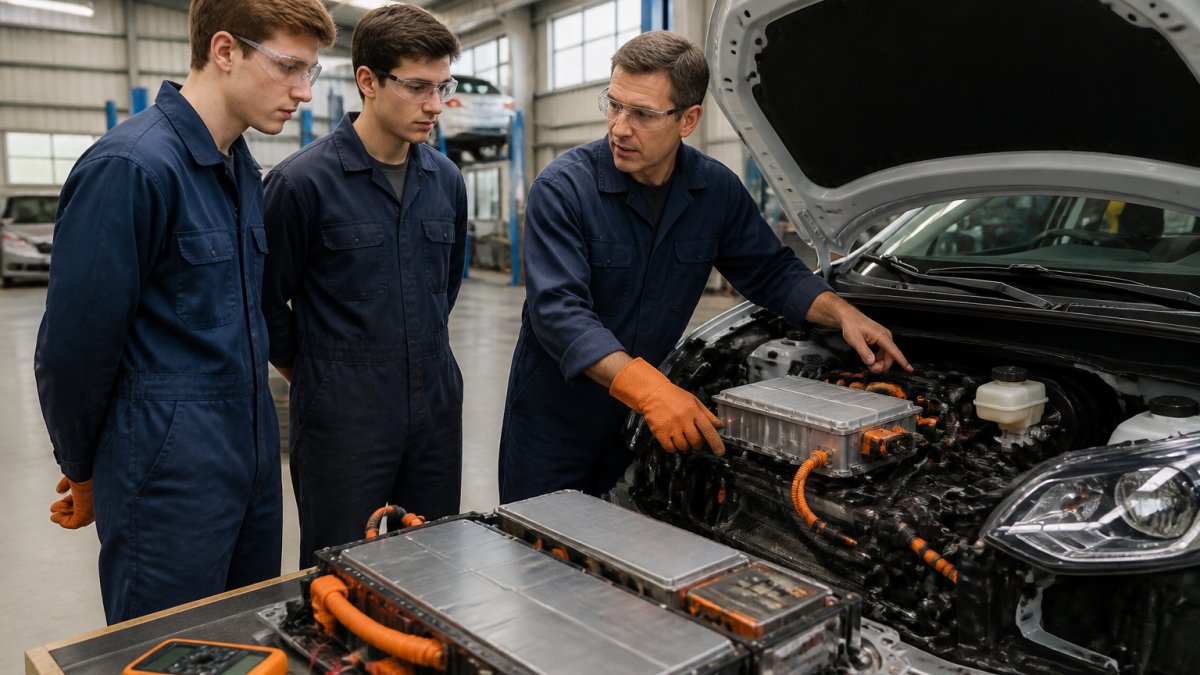
 ultimate-guide
Automotive Electric Vehicle Training Courses: A 2026 Guide
Table of Contents
- Why Automotive Electric Vehicle Training Courses Matter in 2026
- Battery Electric Vehicle Inspection and Servicing Skill Set
- Battery Electric Vehicle Diagnosis and Repair Skill Set
- Certificate III in Automotive Electric Vehicle Technology
- Electric Vehicle Technician Qualifications and Career Pathways
- Choosing the Right Automotive Electric Vehicle Training Courses
- Frequently Asked Questions
Last Updated: October 5, 2026
Why Automotive Electric Vehicle Training Courses Matter in 2026
The shift to electric vehicles has moved from forecast to forecourt, and the technicians who can safely work on them are in short supply. This guide from Swann College covers automotive electric vehicle training courses across the country, from short skill sets through to full qualifications. Electric vehicle training is no longer a niche add-on for a handful of specialists. It is becoming a core competency for anyone who wants to stay employable in the automotive trade.
The reason is straightforward: high-voltage systems demand a different approach to everything a mechanic already knows. You cannot simply unbolt a battery pack the way you would a fuel tank. The work involves isolation procedures, safety interlocks, and an understanding of how battery, motor, and auxiliary systems interact.
The good news is that the pathway into this work is well defined. Nationally recognised training gives you a credential employers actually recognise, whether you are starting out or adding to existing trade qualifications.
Battery Electric Vehicle Inspection and Servicing Skill Set
The Battery Electric Vehicle Inspection and Servicing Skill Set covers the competencies required to inspect and service a battery electric vehicle without touching the high-voltage systems directly.
In practice, this means you learn to:
- Identify high-voltage components and their safety interlocks
- Follow correct depower and reinitialise procedures
- Perform general servicing while respecting the boundaries of the high-voltage system
- Recognise when a job needs a higher-qualified technician
This skill set is a practical, focused credential rather than a full qualification.
Battery Electric Vehicle Diagnosis and Repair Skill Set
The Battery Electric Vehicle Diagnosis and Repair Skill Set prepares technicians to diagnose and repair faults within high-voltage systems themselves.
You learn to work with the battery system, traction motor, and auxiliary systems as an integrated whole. Electrical diagnosis plays a central role, alongside the ability to interpret system instrumentation and safely isolate components before repair.
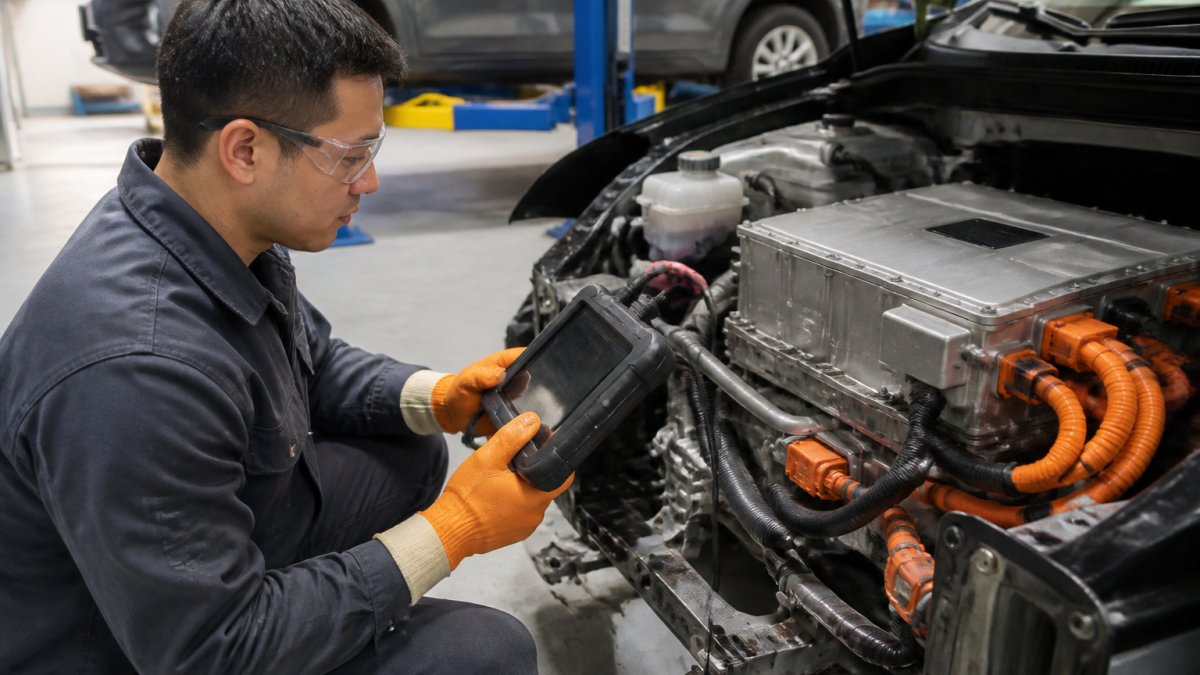
The diagnostic skill set teaches you to follow the evidence rather than replace parts on a hunch.
Certificate III in Automotive Electric Vehicle Technology
The Certificate III in Automotive Electric Vehicle Technology is a full qualification for people building a career around electric and hybrid vehicles, rather than adding a single competency to an existing trade. It combines the practical skills of light vehicle work with the specialised knowledge electric vehicles demand.
Where the two skill sets are short, targeted credentials, a Certificate III is a full apprenticeship-level program. That difference matters in three practical ways: it takes considerably longer to complete, it bundles a broad set of core and elective units rather than one specialism, and it produces a qualification that stands on its own rather than attaching to an existing trade.
The qualification typically covers:
- Hybrid and electric vehicle technology fundamentals
- High-voltage safety and isolation, including depower and reinitialise procedures
- Battery electric and fuel cell electric vehicle systems
- Traction motors and drive systems
- Auxiliary electrical systems and automotive electrical technology
- Automotive mechanical diagnosis across vehicle systems
- System instrumentation and safety interlocks
Because the content spans mechanical and electrical work, the qualification suits people who want to be able to take a vehicle from routine servicing through to fault diagnosis without handing it off. That breadth is the point: a technician who understands how the battery, inverter, motor and auxiliary systems interact can follow a fault to its source instead of replacing parts on a hunch.
Who it suits
- Apprentices building an EV specialism from the start
- Qualified light vehicle mechanics who want a full qualification rather than a short skill set
- Career-changers moving into the automotive trade
- International students who need a nationally recognised qualification
What to check before enrolling
- Whether the qualification is current on the national training register, since training packages are updated over time
- The mix of core and elective units, and whether the electives match the work you actually want to do
- How much of the course is delivered in a workshop on real vehicles rather than online theory
- Whether recognition of prior learning is available for units you can already demonstrate
Matching the credential to the role you want is the decision that saves the most time.
Electric Vehicle Technician Qualifications and Career Pathways
Electric vehicle technician qualifications open doors that a general automotive certificate alone will not.
The career pathways tend to split three ways:
- Workshop technician: servicing and repairing electric and hybrid vehicles as part of a general workshop team
- EV specialist: focusing on diagnosis and repair of battery, motor, and high-voltage systems
- Mobile mechanic: carrying EV servicing capability to customers directly
For international students, a nationally recognised qualification can form part of a skilled migration pathway, though sponsorship and visa outcomes depend on employer demand and current migration rules. It is worth checking the Department of Home Affairs skilled migration information for the latest requirements, as these change over time.
The practical reality is that employers value hands-on competence.
Choosing the Right Automotive Electric Vehicle Training Courses
Choosing between automotive electric vehicle training courses comes down to where you are now and where you want to be. The wrong choice wastes time; the right one gets you working on electric vehicles faster. This section covers the decision factors that actually determine whether a course is right for you: eligibility, prerequisites, delivery mode, practical assessment, and cost.
| If you are... | Consider | Because |
|---|---|---|
| A qualified mechanic adding EV capability | Battery Electric Vehicle Inspection and Servicing Skill Set | Fastest route to safe routine servicing |
| A technician ready for high-voltage repair | Battery Electric Vehicle Diagnosis and Repair Skill Set | Covers diagnosis and repair, not just inspection |
| Starting out or changing careers | Certificate III in Automotive Electric Vehicle Technology | Full qualification with broad, recognised coverage |
| An international student | Certificate III pathway | Builds a qualification employers recognise |
Eligibility and prerequisites
Entry requirements vary by course type, and this is where most people get caught out. Short skill sets generally assume you already hold a relevant trade qualification or can demonstrate equivalent industry experience. A full Certificate III usually has no such assumption and is open to entrants starting from scratch, though you may still need to meet language, literacy and numeracy requirements.
Before you enrol, ask the provider directly:
- What prior qualification or experience is assumed?
- Is there an entry assessment, and what does it cover?
- Can I start on the skill set and ladder into the Certificate III later?
Recognition of prior learning
If you already hold a trade qualification or have years of hands-on experience, recognition of prior learning (RPL) can shorten your course by crediting units you can already demonstrate. RPL is not automatic, it requires evidence, usually a portfolio, workplace references, and sometimes a practical assessment. It is worth asking about early, because it can change both the duration and the cost of your training.
Delivery modes and practical assessment
Online theory has its place, but you cannot learn correct isolation procedure from a video. Look for courses that combine theory with supervised workshop time on actual vehicles, and ask how the practical component is assessed.
- Online or blended theory: flexible, suits working technicians, but only covers knowledge
- On-campus workshop training: hands-on, supervised, and the only way to build real competence
- Workplace-based delivery: training on the job, often tied to an apprenticeship
Ask each provider which campuses have workshop facilities and whether assessment is conducted on real high-voltage vehicles or simulators.
Costs, subsidies and employer funding
Fees vary widely by provider, course type and your circumstances, so treat any figure you see as indicative rather than fixed.
- Government subsidies: state and territory training authorities fund some qualifications and skill sets, particularly where the skills are in demand. Eligibility depends on your location, residency status and whether you are already qualified in the field.
- Employer funding: many workshops pay for staff to complete EV skill sets because it directly expands what the business can service. It is worth asking before you pay out of pocket.
- Apprenticeship support: if you are an apprentice, your training may be covered under your training contract.
Because subsidy arrangements and fee schedules change, confirm current costs directly with the provider and check your state or territory training authority for what is funded in your area.
At Swann College, our courses are developed in association with the Institute of Automotive Mechanical Engineers, so the content stays aligned with current industry practice rather than drifting out of date. We deliver nationally accredited training from campuses in Sydney and Adelaide, with trainers who hold genuine command of their subject.
Frequently Asked Questions
Which EV course is best for automotive technicians?
The best course depends on your current skills and goals. If you already hold a Certificate III in Light Vehicle Mechanical Technology, a battery electric vehicle diagnosis and repair skill set builds directly on that foundation. For those new to the field, a Certificate III in Automotive Electric Vehicle Technology provides the broadest entry point. Check that the course is nationally recognised and includes hands-on high-voltage safety training.
What qualifications do I need to work on electric vehicles?
You need formal training in high-voltage safety and EV systems. A Certificate III in Automotive Electric Vehicle Technology or a battery electric vehicle inspection and servicing skill set covers depowering, reinitialising, and safe isolation procedures. Without recognised training, you cannot legally or safely work on high-voltage systems in a workshop setting.
How long does it take to become an electric vehicle technician?
A full Certificate III typically takes 12 to 24 months depending on delivery mode and whether you are apprenticed. Short skill sets in inspection and servicing can be completed in a few weeks of full-time study or several months part-time. Diagnosis and repair skill sets usually require longer because they build on existing automotive mechanical knowledge and include practical assessment.
Do automotive EV courses include practical, hands-on training?
Look for programs delivered in a workshop environment with real vehicles or high-voltage training rigs. Practical assessment should cover depowering, reinitialising, isolation testing, and fault diagnosis. Ask the training provider how much time is spent on tools versus theory before you enrol.
What is the difference between EV inspection and servicing training and EV diagnosis and repair training?
Inspection and servicing training covers routine maintenance, safety checks, and high-voltage isolation on battery electric vehicles. Diagnosis and repair training goes further into fault finding, component replacement, and system repair. The inspection skill set suits technicians who service EVs but do not repair them. The diagnosis and repair skill set is for those who will troubleshoot and fix high-voltage systems.
Is there an online course that teaches electric vehicles?
Some providers offer online theory components, but practical assessment must be completed in person. High-voltage safety and isolation cannot be taught through video alone. Blended delivery, where theory is online and practical sessions are on campus, is common. Check that the practical component is delivered in a real workshop with functioning EV systems.
The challenge is simple: electric vehicles are arriving faster than qualified technicians can be trained to service them. The opportunity belongs to those who get certified first. Swann College delivers nationally accredited automotive training in a real workshop environment, with courses developed alongside the Institute of Automotive Mechanical Engineers and trainers who know the trade. Enrol with Swann College and build the electric vehicle skills employers are actively looking for.