 how-to
How to Get Automotive Industry Experience: 7 Steps
Table of Contents
- Step 1: Understand What Counts as Automotive Industry Experience
- Step 2: Build the Skills Employers Look For
- Step 3: Apply for Automotive Work Experience Programs
- Step 4: Meet the Automotive Apprenticeship Requirements
- Step 5: Get Manual vs Automatic Transmission Repair Training
- Step 6: Use the Shadowing Approach to Gain On-Job Training
- Step 7: Build a Portfolio and Transition from Another Industry
- Common Mistakes to Avoid When Seeking Automotive Industry Experience
- Frequently Asked Questions
Last Updated: September 30, 2026
Step 1: Understand What Counts as Automotive Industry Experience
Automotive industry experience is any paid or unpaid work that puts you near real vehicles and real customers in a workshop or dealership setting. It covers many roles, not just turning spanners.
Many people assume only qualified mechanics count. That is wrong.
Here is what employers actually count as experience:
- Time as a trade assistant or workshop hand
- Work experience placements during study
- Apprenticeships in light vehicle mechanic or related trades
- Detailing, tyre fitting, or quick lube roles
- Parts interpretation and service advising
- Shadowing a qualified automotive technician
At Swann College, we see students arrive with no formal background but plenty of informal hours under the bonnet. Those hours matter. Employers look for proof you have been in a workshop, handled tools, and followed safety rules.
The key is documentation. Keep a log of every role, even unpaid ones.
Step 2: Build the Skills Employers Look For
Mechanical aptitude gets you noticed, but it is not the only thing that matters. Employers want a mix of practical skills and personal qualities.
Start with the basics. Learn how an engine works, how to check fluids, and how to use hand tools safely. You can pick these up through vocational training or supervised practice.
Then add the soft skills that make you easy to work with:
- Clear communication with customers and team members
- Reliability and punctuality
- Willingness to ask questions
- Ability to follow instructions without cutting corners
- Problem-solving when a job does not go to plan
A common mistake is focusing only on technical skills and ignoring how you come across. A workshop can teach you to change a starter motor. It cannot easily teach you to show up on time every day.
Hard Skills vs Soft Skills: What to Develop First
Develop hard skills first if you have zero workshop exposure. You need to know which end of a torque wrench to hold before anyone will let you near a customer's car.
Develop soft skills first if you already have hands-on experience but keep missing out on jobs. Trainers and workshop owners often say attitude beats aptitude when two candidates are close.
The best approach is to build both at once. Enrol in a course that includes practical workshop time, then treat every interaction as a chance to show you are dependable.
Step 3: Apply for Automotive Work Experience Programs
Automotive work experience programs are structured placements, usually unpaid, that let you spend time in a real workshop while you study or before you commit to a trade. They are one of the fastest ways to get automotive industry experience on your resume.
Most programs run for one to four weeks. Some schools and Registered Training Organisations arrange them for you. Others require you to approach workshops directly.
How to apply:
- Write a short expression of interest letter stating your availability and interest
- Attach a one-page resume listing any practical skills, even hobby-level ones
- Contact local workshops, dealerships, and mobile mechanics in person where possible
- Follow up after one week if you have not heard back
- Be flexible on start dates and hours
The Fair Work Ombudsman guidance on unpaid work experience explains when a placement can be unpaid and what entitlements still apply. Read it before you accept anything.
Step 4: Meet the Automotive Apprenticeship Requirements
Automotive apprenticeship requirements vary by state and trade, but the core steps are similar. You usually need to be at least 15 years old, have completed Year 10 or equivalent, and be willing to enrol in a nationally accredited qualification.
Some employers ask for a pre-apprenticeship course. Others will take you straight from a work experience placement if you impressed them.
What most guides miss is that you can start before you have a formal offer. Enrol in a Certificate II in Automotive Vocational Preparation, complete the practical units, then use that as proof of commitment when you apply.
For international students, an apprenticeship is not always the right pathway. A nationally accredited qualification can support a skilled migration application, but you should check current requirements with the Department of Home Affairs before you plan around it.
Step 5: Get Manual vs Automatic Transmission Repair Training
Most people searching for automotive industry experience do not yet need to specialise in transmissions. What they need is a way to prove mechanical aptitude to an employer. That is where a documented DIY project beats a niche technical course every time.
This is the gap most guides miss. Competitors tell you to "get hands-on experience" but never explain how to turn hobbyist work into evidence a workshop owner will actually read. Here is how.
Build a portfolio that works for non-mechanics.
You do not need a workshop to start. You need a vehicle, a notebook, and a phone camera.
- Before photos showing the fault or the worn part
- A parts list with part numbers and where you sourced them
- A short written log of the steps, including what went wrong
- After photos and a note on how the vehicle drove afterwards
- A one-line reflection on what you would do differently next time
Translate skills from other industries.
| Your background | What it proves in a workshop |
|---|---|
| Retail or hospitality | Customer communication, handling complaints, working under time pressure |
| Warehousing or logistics | Parts handling, stock accuracy, workplace safety discipline |
| Truck or delivery driving | Vehicle familiarity, fault reporting, logbook discipline |
| Building or electrical trades | Tool competence, reading diagrams, safe isolation procedures |
| Any shift-based role | Reliability, punctuality, ability to work a roster |
Where transmission training actually fits.
Step 6: Use the Shadowing Approach to Gain On-Job Training
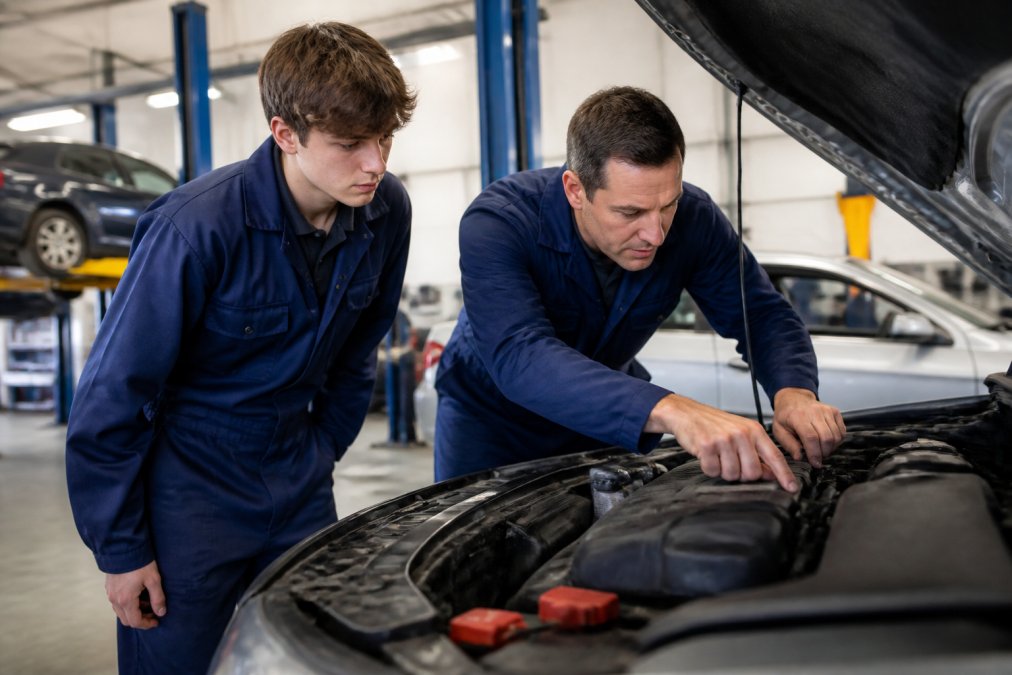
Shadowing means following a qualified automotive technician through their day, watching how they diagnose faults, talk to customers, and manage their time. It is not the same as doing the work yourself, but it builds industry insight fast.
Step 7: Build a Portfolio and Transition from Another Industry
Transitioning from another industry is more common than you might think. Former retail workers, drivers, and tradespeople from other fields all bring transferable skills, but only if they present those skills in a way a workshop owner recognises.
What a portfolio actually needs to contain.
- The vehicle (make, model, year, and odometer reading if you have it)
- The symptom or task in plain language
- The tools you used, including any you had to borrow or buy
- The steps you followed, in order
- What went wrong and how you resolved it
- A photo of the finished work
- A one-sentence reflection on what you would do differently
Translate your previous role into workshop language.
- "Managed a busy retail floor" becomes "Handled customer complaints and worked to tight timeframes in a high-pressure environment"
- "Warehouse picker" becomes "Maintained stock accuracy, followed safety procedures, and operated equipment to schedule"
- "Delivery driver" becomes "Reported vehicle faults, kept logbooks, and managed routes independently"
- "Builder's labourer" becomes "Competent with hand and power tools, comfortable reading plans, and trained in site safety"
Approach workshops the way you would approach a job.
Use the shadowing approach as your entry point.
Where training fits.
Common Mistakes to Avoid When Seeking Automotive Industry Experience
The biggest mistake is waiting until you feel ready. Nobody feels ready. Apply for placements, ask to shadow, and enrol in training while you are still unsure.
Other mistakes we see often:
- Applying only to large dealerships and ignoring small workshops
- Skipping safety training or ignoring workplace rules
- Treating unpaid placements as unimportant
- Failing to follow up after an application
- Not asking for feedback when you miss out on a role
Frequently Asked Questions
How do you get into the automotive industry without prior experience?
Start with an automotive work experience program or a nationally accredited Certificate II in Automotive. These entry-level pathways teach basic automotive maintenance, tool use and workshop safety before you commit to a full apprenticeship. Shadowing a qualified light vehicle mechanic for a week also gives you practical skills and a referee for future job applications. Many Registered Training Organisations run short courses that count toward your first apprenticeship application.
What are the automotive apprenticeship requirements?
You generally need to be at least 15 years old, have completed Year 10 or equivalent, and be an Australian citizen, permanent resident or hold a visa with work rights. Employers also look for mechanical aptitude, a current driver's licence and a safety-first attitude. Most automotive apprenticeship requirements include enrolling in a Certificate III in Light Vehicle Mechanical Technology with a Registered Training Organisation, which combines on-the-job training with classroom learning over three to four years.
Is 27 too old to become a mechanic?
No. Mature-age apprentices are common in the automotive trades, and employers often prefer them because they bring reliability, prior work experience and stronger customer communication skills. Your age is not a barrier to meeting automotive apprenticeship requirements. What matters is your mechanical aptitude, willingness to learn and ability to work in a team. Many career-changers start in their 30s and 40s and progress quickly into specialisations like EV systems or air conditioning.
What skills do employers look for in entry-level automotive applicants?
Employers want a mix of technical skills and soft skills. On the technical side: basic automotive maintenance, familiarity with tools and equipment, and an understanding of workshop safety. On the soft side: reliability, teamwork, clear communication and a willingness to ask questions. A pre-apprenticeship or automotive work experience program gives you evidence of both. Building a simple portfolio of jobs you have completed, even informal ones, also sets you apart from other applicants.