 how-to
Nationally Accredited Automotive Air Conditioning Course
Table of Contents
- What Makes a Nationally Accredited Automotive Air Conditioning Course
- AUR20220 Certificate II in Automotive Air Conditioning Technology
- Refrigerant Handling Licence Requirements for Technicians
- How Long Does an Automotive Air Conditioning Course Duration Take?
- Step-by-Step Enrolment Guide for a Nationally Accredited Automotive Air Conditioning Course
- Cost vs ROI: What You Actually Get for Your Investment
- Prerequisite Mapping and Career Pathways
- Common Mistakes to Avoid When Choosing a Course
- Frequently Asked Questions
Last Updated: September 28, 2026
What Makes a Nationally Accredited Automotive Air Conditioning Course
A nationally accredited automotive air conditioning course is listed on the national training register and delivered by a Registered Training Organisation, so your qualification is recognised nationwide by employers and licensing bodies.
The practical difference shows up in three places:
- Your qualification is portable between employers and states
- Your refrigerant handling training meets the competency standard regulators expect
- Your assessment is validated against the national training package, not a provider's own checklist
AUR20220 Certificate II in Automotive Air Conditioning Technology
The AUR20220 Certificate II in Automotive Air Conditioning Technology is the national qualification for technicians who service, diagnose and repair vehicle air conditioning systems, including refrigerant recovery, recycling and rectification. It is designed for people entering the specialisation or adding it to an existing mechanical trade; you do not need to be a fully qualified mechanic to start, though mechanical background helps.
Core Units and Refrigerant Handling Standards
Australia regulates these substances under federal environment law, and the Australian Government Department of Climate Change, Energy, the Environment and Water sets out the obligations for anyone who handles ozone-depleting substances and synthetic greenhouse gases. Course content is built to match those obligations, not to work around them.
Assessment and Skill Validation
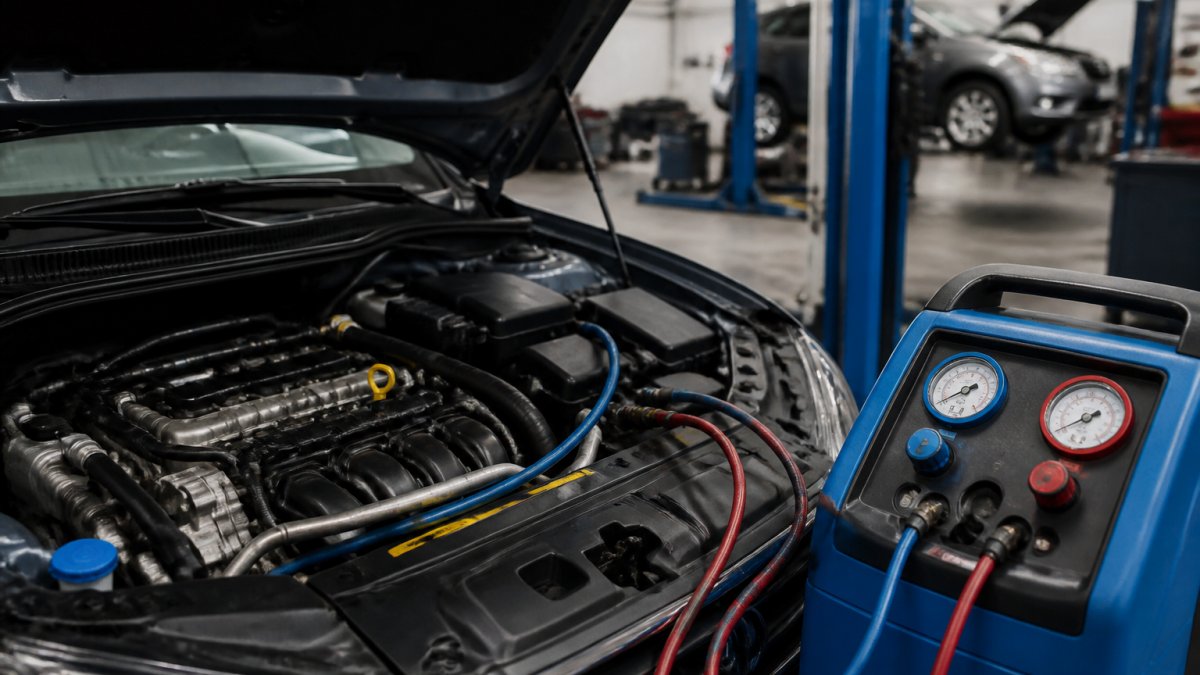
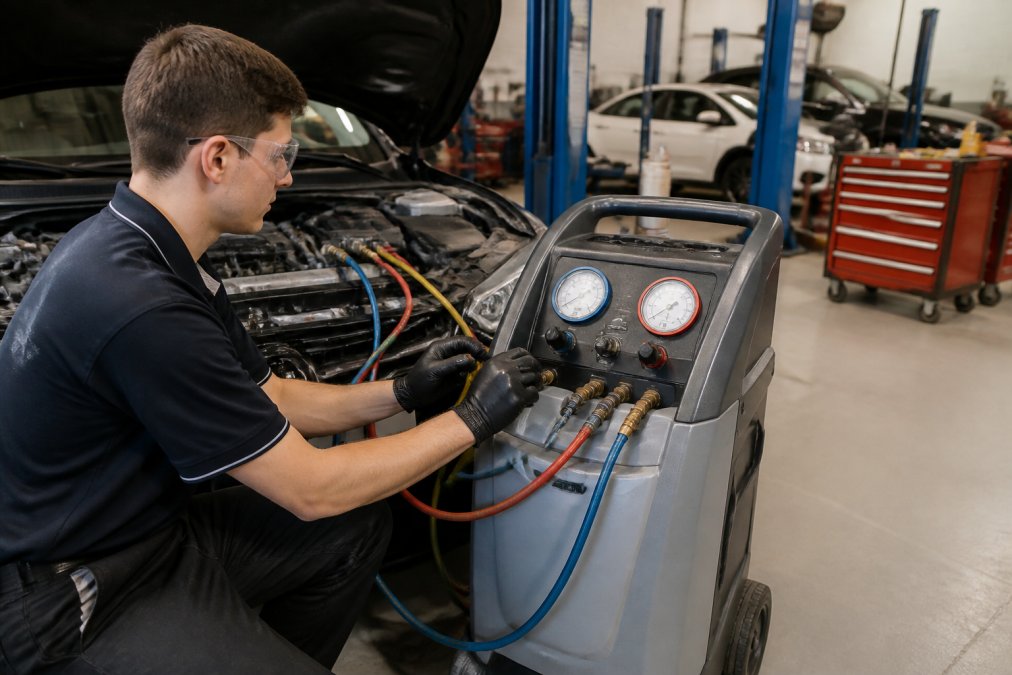
Assessment combines theory with hands-on tasks on real vehicles in a workshop environment. Skill validation means an assessor watches you perform tasks, online-only courses fall apart here, because there is no substitute for connecting gauges to a live system. Swann College's training facility reflects a real workplace, so the equipment you learn on is the equipment you will use on the job.
Refrigerant Handling Licence Requirements for Technicians
In practice, that means completing accredited training that includes the relevant refrigerant handling units, then applying for a licence through your state regulator. The Australian Refrigeration Council administers the national refrigerant handling licence scheme on behalf of the federal government, and it publishes the competency requirements your course must meet.
How Long Does an Automotive Air Conditioning Course Duration Take?
Course duration typically runs from a few weeks of full-time study to several months of part-time delivery, depending on your starting point and the provider's unit structure.
| Study Mode | Typical Duration | Best For |
|---|---|---|
| Full-time, on campus | Weeks to a few months | Career changers with available days |
| Part-time | Several months | Employed technicians |
| Evening delivery | Several months | Full-time workers needing one certification |
| Block release | Depends on employer arrangement | Apprentices and workshop staff |
Part-Time and Evening Study Options
Part-time and evening delivery exists for people already working in a workshop who need one specific certification rather than full retraining. The trade-off: it spreads the cost and fits around a job, but stretches the time between learning a skill and practising it. Ask any provider two questions before enrolling: how many hours are delivered face to face, and how much of that is practical workshop time.
Step-by-Step Enrolment Guide for a Nationally Accredited Automotive Air Conditioning Course
Enrolment is simpler than most people expect, but the order matters, get a step out of sequence and you can pay for training you cannot use.
-
Confirm the provider is a Registered Training Organisation and the qualification code appears on the national register.
-
Check the entry requirements, including any language, literacy and numeracy assessment.
-
Decide between full-time, part-time and evening delivery based on your work commitments.
-
Prepare your identification and any prior qualification documents for recognition of prior learning.
-
Submit your enrolment form and confirm your start date in writing.
Cost vs ROI: What You Actually Get for Your Investment
Government portals list courses; providers list prices; nobody connects the two. Here is the framework to apply before you pay a deposit.
What Drives the Fee
Course fees are not set nationally. They vary by provider, delivery mode, and, critically, whether you are eligible for a government-subsidised place. The main variables:
- Delivery mode. Face-to-face delivery costs more to run than online theory, and practical workshop hours are the single largest cost driver.
- Funding eligibility. Most states and territories subsidise priority qualifications through a state training authority, usually based on residency status, prior qualifications, and industry employment.
- Apprenticeship status. If you are completing the qualification as part of an Australian Apprenticeship, your training may be funded through the apprenticeship system rather than paid upfront.
- Recognition of prior learning. RPL can reduce the units you pay for, but providers typically charge an assessment fee per unit. Ask for the RPL fee schedule separately from tuition.
The Three Return Streams
ROI on this qualification comes from three places, and only one is the wage.
- Employability in a specialisation. General mechanical roles are competitive; air conditioning is narrower, and workshops that cannot find a licensed technician will pay for one.
- Pathway to further qualifications. The Certificate II units articulate into higher automotive qualifications, so units you complete here count toward a Certificate III or diagnostic specialisation rather than being repeated.
The Honest Payback Question
The right question is not "will this course pay for itself" but "how many additional jobs per month does this qualification let me book, and what is the margin on each?" A technician adding even a modest number of services per week recovers the course cost through work previously turned away; a career changer with no customer base has a longer runway.
Funding and Support to Ask About
Before you assume you are paying full fee, ask the enrolment team four questions:
- Is this qualification currently subsidised in my state or territory, and am I eligible?
- Do you offer a payment plan, and is there any interest or admin fee attached?
- Can I claim recognition of prior learning on any units, and what does the assessment cost?
- Are there any materials or PPE costs not included in the advertised fee?
Prerequisite Mapping and Career Pathways
Most guides tell you what you can do after the course, not what you need before it. This section fills that gap.
Entry Requirements in Plain Terms
Formal entry requirements are lighter than a trade qualification. In practice, providers typically require:
- Language, literacy and numeracy (LLN) assessment. Most Registered Training Organisations screen applicants to confirm they can read technical documentation, interpret pressure and temperature charts, and complete written assessments.
- Minimum age. Usually 15 or 16, depending on the state or territory, with extra requirements for students under 18.
- No mandatory prior trade qualification. You do not need to be a qualified mechanic to enrol, though mechanical background materially shortens the pathway.
Foundational Units That Sit Underneath the Specialisation
If you are entering without a mechanical trade, expect automotive fundamentals, typically covering:
- Workplace health and safety in an automotive environment
- Use of hand tools, measuring equipment, and workshop machinery
- Basic electrical principles, including circuits, multimeters, and wiring diagrams
- Vehicle systems overview, including how the air conditioning system integrates with the engine, electrical, and cabin systems
How Recognition of Prior Learning Actually Works
RPL is not a discount and not automatic, it is an assessment process. You provide evidence (prior qualifications, statements of attainment, employer references, or a practical demonstration) and an assessor maps it against the unit requirements. A common pattern: experienced technicians get RPL on the foundational units but still complete the refrigerant handling and air conditioning units in full, because the licence depends on them.
Career Pathways From Here
The qualification opens several routes, and they are not mutually exclusive:
- Automotive air conditioning technician in a general workshop, handling service, diagnosis, and repair alongside general mechanical work.
- Specialist mobile air conditioning repair, where you travel to vehicles rather than the vehicle coming to you, suited to technicians who want a customer base without workshop overheads.
- Refrigeration servicing roles that cross into automotive work. The refrigerant handling competencies overlap, though the licensing frameworks are separate and you should confirm which licence applies.
- Further study toward a Certificate III or higher automotive qualification, with the units you complete here counting toward it.
Checking the Qualification Before You Commit
The qualification code and the provider's registration status are both verifiable. The Victorian Registration and Qualifications Authority and its interstate equivalents maintain the registers that confirm which qualifications and providers are accredited. Cross-check the qualification code against the national training register before you pay anything.
Common Mistakes to Avoid When Choosing a Course
Most bad course decisions come down to a handful of avoidable errors.
Frequently Asked Questions
Do I need a nationally accredited qualification to regas car air conditioning?
To handle certain refrigerants, you may need a specific licence. A nationally accredited automotive course can provide training and assessment relevant to various automotive specialisations.
How long does an automotive air conditioning course take to complete?
Course duration varies by provider and delivery mode. Part-time and evening options may be available for technicians already working in a workshop who need a specific certification.
What is the difference between a refrigerant handling licence and a trade certificate?
A refrigerant handling licence is a regulatory requirement that allows you to buy and handle certain refrigerant gases. A trade certificate is a vocational qualification that proves your technical skills, accredited units and performance outcomes.
Can I complete automotive air conditioning training online?
Theory components can often be delivered online, but practical assessment must be completed in a real workshop environment. Nationally accredited courses require hands-on skill validation, so look for a provider with an automotive workshop training facility rather than a fully online option.