 Ultimate guide
Automotive Trade Career Path Australia 2026: The Complete Guide
Last Updated: November 1, 2026
Quick Summary
An automotive trade career path in Australia typically starts with a Certificate III in Light Vehicle Mechanical Technology, delivered through an apprenticeship that combines paid workshop employment with off-the-job training. Most apprenticeships run about four years, and you qualify as a tradesperson after a final trade assessment.
- Most employers and training organisations expect at least Year 10, with many preferring Year 12.
- A school-based apprenticeship in Years 11 and 12 lets you start the Certificate III while still at school.
- Recognition of prior learning can shorten the formal training component but does not replace the apprenticeship.
- The Certificate IV in Automotive Mechanical Diagnosis suits technicians moving into complex diagnosis and supervision.
- Electric and hybrid vehicle skills are the clearest growth area, with technicians who hold them in short supply.
Table of Contents
- Why the Automotive Trade Is a Smart Career Move in 2026
- Automotive Trade Occupations: The Roles You Can Target
- How to Become a Motor Mechanic: A Step-by-Step Pathway
- Automotive Apprenticeship Duration and What It Involves
- The Automotive Electrician Career Path Explained
- Automotive Career Progression: Where the Trade Can Take You
- Pay, Training Costs and Apprentice Support in 2026
- Electric and Hybrid Vehicle Skills: The Fastest-Growing Specialisation
- Frequently Asked Questions
Why the Automotive Trade Is a Smart Career Move in 2026
An automotive trade career path in Australia has rarely looked more practical.
The trade suits people who learn by doing: you work with your hands, diagnose real faults, and finish each day with something concrete to show.
The honest version: the work is physical, the first few years are poorly paid, and you will spend a lot of time on your feet.
Automotive Trade Occupations: The Roles You Can Target
The automotive trade is not one job but a cluster of occupations with different tools, conditions and pay ceilings. Knowing which one you want shapes every training decision afterwards.
Light Vehicle and Motor Mechanic Roles
A motor mechanic services and repairs cars and light commercial vehicles: engines, brakes, suspension, steering, cooling and transmission work. Most start as apprentices in a workshop or dealership, and the trade qualification they earn is the foundation for almost every other path in the industry.
Heavy Vehicle, Electrical and Body Trades
A diesel mechanic works on trucks, buses and heavy equipment, where diagnostic work is heavier and pay tends to run higher than light vehicle servicing. An automotive electrician handles wiring, batteries, sensors and electronic control systems, a role that grows more important with every new model. Panelbeaters repair damaged bodywork, while vehicle painters handle refinishing and colour matching. Workshop controllers run the floor and diagnostic specialists take on the faults nobody else can solve.
How to Become a Motor Mechanic: A Step-by-Step Pathway
The pathway can branch depending on who you are when you start, school leaver, career changer, mature-age entrant, or someone with overseas trade experience. The map below shows the common trunk and the branches, so you can see where you actually enter.
The common trunk (everyone follows this)
- Meet the entry standard. Most employers and Registered Training Organisations expect at least Year 10, and many prefer Year 12 or equivalent. There is no single national licensing exam to become a motor mechanic, the trade is competency-based, but you must complete a nationally recognised qualification and be assessed as competent.
- Secure an apprenticeship or traineeship. This is the gate. You need an employer willing to take you on, because the qualification is delivered on the job as well as off the job.
- Sign a training contract. Your employer, you and the RTO formalise the arrangement through the relevant state or territory apprenticeship authority, making you an apprentice in the eyes of the funding system, not just an employee.
- Enrol in the Certificate III in Light Vehicle Mechanical Technology. This is the standard trade qualification for light vehicle work. It is listed on training.gov.au, where you should verify any course before paying a deposit.
- Build workplace hours and complete off-the-job training. You are assessed against competency standards in a real workshop while attending structured training with your RTO.
- Pass trade assessment and qualify. Once your competencies are signed off, you are a qualified tradesperson, the foundation for every specialisation that follows.
The branches (where your starting point changes the route)
Career changer. You still need the Certificate III and an employer, but the practical difference is income.
Mature-age entrant with overseas experience. Your overseas qualification is not automatically recognised.
Already qualified in another trade. Cross-trade recognition can credit some units, particularly in shared areas like workplace safety, tools and basic diagnostics, but you will still complete the light vehicle-specific competencies.
State and territory differences you must check
Australia does not run one uniform apprenticeship system. The qualification is national, but the administration is not:
- Training contracts, probation periods and apprentice registration are handled by the state or territory apprenticeship authority, and the forms, timelines and dispute processes differ.
- **
- High-risk work and electrical licensing sit with state work health and safety and electrical regulators. If you later specialise in automotive electrical work or air conditioning, additional state-based licensing or refrigerant handling requirements may apply, check with your state regulator before enrolling.
The mistake that costs apprentices years
An apprentice who spends three years doing oil changes and tyre fitting will struggle at trade assessment, because the competency standards require evidence across engines, brakes, steering, suspension, cooling and diagnostics. Ask at interview how work is allocated, whether you will be paired with a qualified technician, and what happens when a complex diagnostic job comes in.
The full process, including how to approach employers and what to put in an application, is covered in more detail in our guide on how to become a mechanic.
Automotive Apprenticeship Duration and What It Involves
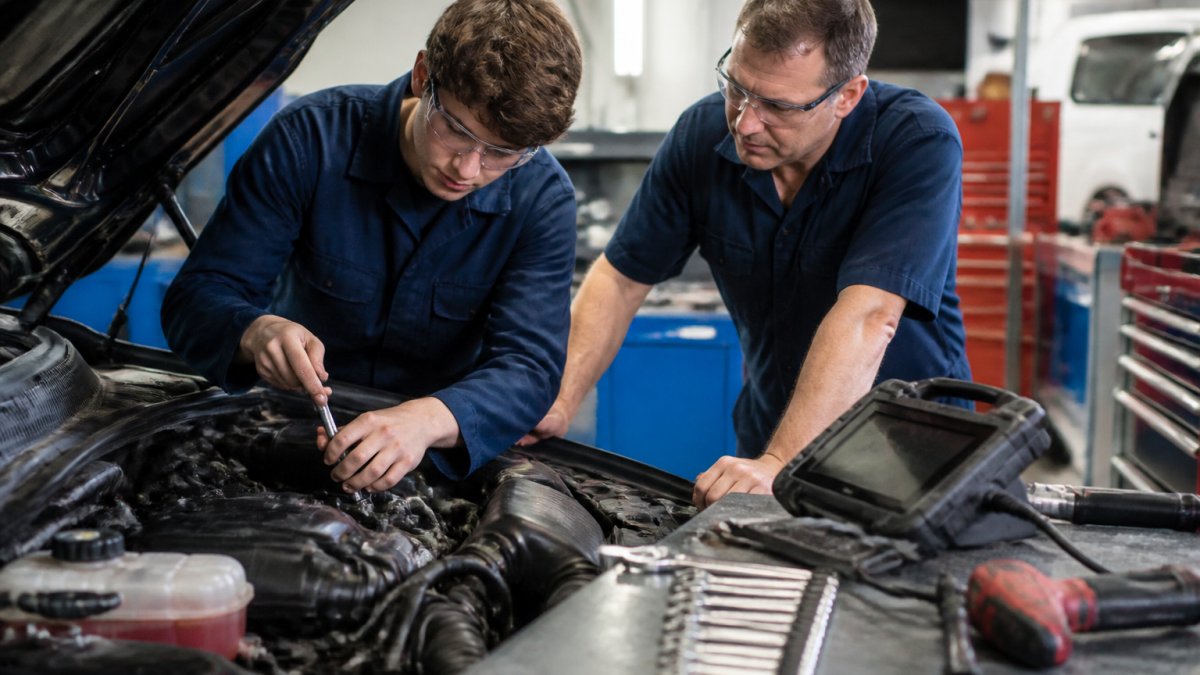
Automotive apprenticeship duration typically runs about four years for a full trade qualification, though the exact time depends on your employer, your training provider and whether you already hold relevant prior learning.
What it involves is straightforward: you work under supervision, you study, and you gradually take on more responsibility as your competence grows.
The structure usually combines:
- Paid employment in a workshop or dealership
- Structured off-the-job training with a Registered Training Organisation
- Logged workplace hours and competency assessments
Here is the shape of a typical automotive apprenticeship at a glance.
| Item | Detail |
|---|---|
| Typical duration | About four years for a full trade qualification |
| Duration depends on | Employer, training provider, relevant prior learning |
| Paid work | Employment in a workshop or dealership |
| Off-the-job training | Structured training with a Registered Training Organisation |
| Assessment | Logged workplace hours and competency assessments |
| To qualify | Final trade assessment |
| Pay while training | Earn while you learn; wage rises with each stage |
The Automotive Electrician Career Path Explained
The automotive electrician career path is one of the more technical routes in the trade, and it is becoming more valuable as vehicles shift toward complex electronics.
Entry usually starts with an automotive electrical apprenticeship or a Certificate III in Automotive Electrical Technology.
If that route appeals, you can look at the Certificate III in Automotive Electrical Technology to see what the course covers.
Automotive Career Progression: Where the Trade Can Take You
Automotive career progression is more flexible than most people assume. The trade qualification is a licence to keep learning, and the people who advance fastest add specialisations rather than staying in one lane.
Typical progression looks like this:
- Apprentice to qualified tradesperson after trade assessment
- Qualified technician to diagnostic specialist as your fault-finding skills sharpen
- Specialist to workshop controller or team leader, managing workflow and staff
Further qualifications open doors to senior technical and diagnostic roles. The Certificate IV in Automotive Mechanical Diagnosis is the next qualification for technicians who want to move beyond routine servicing into complex diagnosis and supervision. for technicians who want to move beyond routine servicing into complex diagnosis and supervision.
Pay, Training Costs and Apprentice Support in 2026
This is the section most guides duck, and it is the one that decides whether a career change is viable. The honest answer is that automotive pay is not a single number, it depends on your occupation, your stage, your state, and whether you are award-covered or on a workplace agreement. What follows is a framework for reading the numbers yourself, plus the mechanisms that actually move your take-home pay.
How apprentice and tradesperson pay is actually set
Automotive employees may be covered by an award or an enterprise agreement, and the applicable one depends on the workplace. Your pay steps up automatically as you progress, provided your training and competency sign-offs keep pace.
A practical pattern most apprentices experience:
- Stage 1 (first year): a training wage, often around half the qualified rate depending on the award classification and whether you are a school-based or adult apprentice.
- Stage 2-3: incremental rises as competencies are signed off; adult apprentices (21+) are usually paid at a higher minimum than junior apprentices.
- Stage 4 / final year: close to the qualified rate, with the gap closing at trade assessment.
Check the current award rates with the Fair Work Ombudsman, and ask the employer which classification and agreement applies to you before you sign.
Training costs and what drives them
The cost of the qualification itself is rarely the full picture. Three things determine what you actually pay out of pocket:
- Whether the qualification is subsidised in your state. Apprenticeship and traineeship funding is administered by state and territory training authorities, and eligibility rules, priority qualification lists and student contribution amounts differ between them. A qualification heavily subsidised in one jurisdiction may attract a much higher fee in another.
- Whether your employer contributes. Many workshops cover some or all of the off-the-job training fees, tool allowances or travel; others do not. This is negotiable and worth raising before you enrol.
- What is bundled into the fee. Resource fees, PPE, tool kits and first-aid or high-voltage short courses are sometimes included and sometimes charged separately.
Because subsidy settings and apprentice incentive arrangements are reviewed regularly and have changed repeatedly in recent years, treat any dollar figure you read online, including on training provider sites, as indicative only and confirm it with the provider and your state training authority for the current intake. The Skills SA Subsidised Training Student Guide sets out how to check funding eligibility.
Support beyond the wage
Apprentice support is more than the hourly rate. The mechanisms that matter in practice include:
-
Trade support loans and apprentice income support administered through the federal government, which eligible apprentices can access to offset tool and living costs, check eligibility and repayment settings against current government guidance.
-
Employer mentoring and structured supervision, which is not a payment but is the single biggest determinant of whether an apprentice completes.
If you are a career changer, also factor in the opportunity cost of the training-wage years. The trade-off is real: lower earnings for roughly four years, then a qualified rate with overtime and specialisation upside that an entry-level desk role rarely matches. Run the numbers against your own circumstances rather than a generic salary article.
Electric and Hybrid Vehicle Skills: The Fastest-Growing Specialisation
Electric and hybrid vehicle skills are the clearest growth area in the trade, and technicians who hold them are in short supply.
If you already hold a trade qualification, adding hybrid and EV servicing skills is one of the fastest ways to raise your value. The hybrid electric vehicle inspection and servicing skill set covers the practical competencies employers now look for.
Electric vehicle training can be a useful addition for technicians entering the trade.
The automotive trade rewards people who commit to learning properly, and the pathway is clearer than most industries allow.
Frequently Asked Questions
Are motor mechanics in demand in Australia?
Yes. Automotive trades offer ongoing employment opportunities for qualified technicians. Demand is strongest for technicians who can handle diagnostics, vehicle electrical systems and electric or hybrid vehicles. Dealerships and independent workshops both compete for the same pool of qualified staff, which keeps employment opportunities steady for people entering the automotive trade. Completing a nationally accredited qualification and building hands-on experience gives you the strongest position when applying.
How long does an automotive apprenticeship take to complete?
A standard light vehicle automotive apprenticeship runs for about four years as a full-time arrangement, combining paid on-the-job training with off-the-job study toward a Certificate III. The automotive apprenticeship duration can shorten if you already hold relevant prior learning or a related qualification, and some pathways allow part-time arrangements. Your training provider and employer agree on the structure, and you earn while you learn throughout. Speak to the RTO about recognition of prior learning before you enrol.
Is 27 too late to become a mechanic?
No. Mature-age apprentices are common in the automotive trade, and employers often value the reliability and work habits that come with prior work experience. You will train alongside younger apprentices and follow the same qualification pathway. The main practical considerations are the apprentice wage while you learn and the physical demands of workshop work. Career-changers frequently move into the trade through a Certificate II pre-apprenticeship or a Certificate III pathway before seeking an employer.
Can an automotive trade qualification support a move into automotive electrical work?
Yes. An automotive electrician career path often begins with a light vehicle mechanical qualification, then builds specialist electrical and diagnostic skills through further study. Vehicle electrical systems, ADAS features and high-voltage EV components all demand strong diagnostic ability, and technicians who combine mechanical knowledge with electrical expertise are in short supply. A Certificate III in automotive electrical technology or a short EV course can open this specialisation without starting your training from scratch.
What apprentice incentives may be available in 2026?
Apprentice support schemes can change over time, so check current program rules with the relevant government authority before relying on any incentive. Your RTO can also explain how training fees and payment plans work alongside any incentive you receive.
What automotive trade jobs are likely to be in demand over the next five years?
Automotive careers span light vehicle, heavy vehicle, electrical and body trades, and electric and hybrid vehicle servicing is an area of growing interest for technicians. Workshop controllers and diagnostic specialists are also sought as workshops invest in more complex equipment.