 How-to
How to Build Automotive Workshop Safety Training
Last Updated: October 26, 2026
Quick Summary
Automotive workshop safety training in Australia starts with the legal duty of care every person in a workshop holds under work health and safety law. Build your program by identifying hazards, running a signed induction checklist, and writing task-specific controls with competency sign-off for high-risk jobs such as hoists, tyres, welding and hybrid vehicles.
- The model WHS Act places the primary duty of care on the person conducting the business.
- Record each hazard and who is exposed, then use that list as your training plan backbone.
- Only trained, competent staff should operate a hoist, with apprentices supervised until signed off.
- Drill emergency response at least annually and after layout, alarm or contact changes.
- Keep a training matrix listing every worker against every task they are authorised to perform.
Table of Contents
- Why Automotive Workshop Safety Training Starts With WHS Duties
- Automotive Workshop Hazard Identification: The First Step of Any Program
- How to Run a Workshop Safety Induction Checklist for New Staff
- Vehicle Hoist Safety: Training Controls That Prevent Crush Injuries
- Automotive Workshop PPE: What to Specify and How to Enforce It
- Task-Specific Controls for Common Workshop Jobs
- Emergency Response, Incident Reporting and Refresher Triggers
- Enrol Your Team in Nationally Accredited Automotive Training
- Frequently Asked Questions
Why Automotive Workshop Safety Training Starts With WHS Duties
Automotive workshop safety training in Australia begins with one legal fact: every person in a workshop has a duty under work health and safety law, and automotive workshop safety training in Australia is how that duty gets met.
The model WHS Act places a primary duty of care on the person conducting the business. That duty covers workers, contractors, apprentices and visitors. It cannot be handed off to a sign on the wall.
Training is a control measure, not paperwork. When something goes wrong, regulators ask what instruction, training and supervision the business provided.
Who Holds a Duty of Care in the Workshop
Everyone in an automotive workshop carries some duty. The owner or manager holds the primary duty. Supervisors must ensure work is done safely. Workers must follow procedures and report hazards.
- Managers: provide training, safe systems and supervision
- Supervisors: enforce procedures and correct unsafe acts
- Workers and apprentices: follow controls and raise concerns
Duties are similar across states and territories, but the regulator and some details differ. Check the rules for your own jurisdiction.
Automotive Workshop Hazard Identification: The First Step of Any Program
Automotive workshop hazard identification is the process of finding every task, tool and substance that could hurt someone, before training is designed. You cannot train people on hazards you have not named.
Walk the workshop and list hazards by area. Include the tasks people actually do, not just the obvious ones.
- Vehicle lifts, jacks and stands
- Moving vehicles and blind spots
- Tyre equipment and compressed air
Record each hazard and who is exposed. That list becomes the backbone of your training plan.
How to Run a Workshop Safety Induction Checklist for New Staff
A workshop safety induction checklist is a fixed set of items every new starter covers before touching a vehicle. Run it on day one, every time, and sign it off.
Work through this list with each new worker:
- Tour the workshop and mark exits, first aid and fire gear
- Explain emergency procedures and alarm signals
- Show how to isolate and lock out equipment
The Safe Work Australia guidance on induction and training is a useful reference for what induction should cover. Keep the signed checklist on file.
Vehicle Hoist Safety: Training Controls That Prevent Crush Injuries
Vehicle hoist safety is the single highest-risk area in most workshops. Crush injuries happen when a vehicle drops, tips or is loaded off-centre.
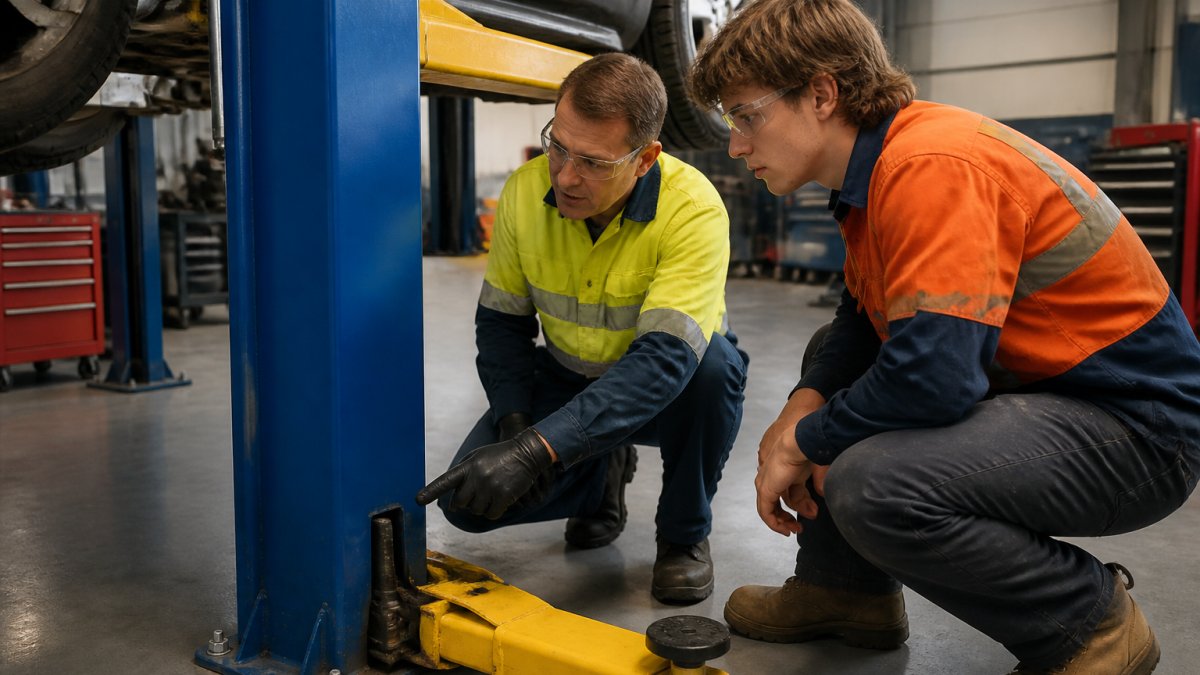
Every worker who uses a hoist should be trained to:
- Check the hoist's rated capacity against the vehicle
- Position lifting arms on the correct manufacturer points
- Confirm the vehicle is balanced before raising
Watch out: the most common mistake is rushing the pre-lift check on a busy day. That is exactly when a vehicle tips.
Only trained, competent staff should operate a hoist. Apprentices work under supervision until signed off.
Automotive Workshop PPE: What to Specify and How to Enforce It
Automotive workshop PPE is only useful if it is specified for each task and enforced every shift. Generic "wear PPE" signs do nothing.
Match the gear to the job:
- Safety glasses: grinding, cutting, air tools, under-vehicle work
- Gloves: handling sharp parts, chemicals and hot components
- Hearing protection: impact tools and loud equipment
Enforcement comes down to supervisors. If a supervisor walks past missing glasses, the rule is dead. Replace damaged PPE without argument and keep spares on hand.
Task-Specific Controls for Common Workshop Jobs
Task-specific controls are the written steps, hazards and competency requirements for each high-risk job in the workshop. One general induction is not enough. The table below is the level of detail each task needs before anyone is signed off to perform it unsupervised.
Vehicle Lifts, Jacks and Stands
- Hazards: crush, struck-by, vehicle drop, off-centre loading
- Controls: rated-capacity check, manufacturer lifting points, balance check before raising, mechanical locks engaged, stands placed under the chassis rails, never under an unsupported vehicle
- Competency: supervised lifts until the pre-lift check is completed correctly three times in a row, then signed off by a supervisor
Tyre Fitting and Inflation
- Hazards: explosive tyre failure, flying debris, compressed-air injection injuries
- Controls: inflation cage for truck and high-pressure tyres, clip-on chuck with an extension hose so the operator stands out of the blast zone, inspection for damage before inflation, never exceed the tyre sidewall pressure
- Competency: cage use and inspection signed off before solo work
Welding and Grinding
- Hazards: fire, burns, eye damage, fume exposure, electric shock
- Controls: welding screens, fire watch for at least 30 minutes after hot work, ventilation or extraction, correct filter shade, isolated earth return, no welding near fuel or solvent vapours
- Competency: hot-work permit and fire-watch training recorded before any welding on a vehicle
Fuel and Battery Work
- Hazards: fire, explosion, acid burns, hydrogen gas accumulation
- Controls: no ignition sources, spill kit on hand, eye wash within reach, battery charging in a ventilated area, correct PPE including face shield and acid-resistant gloves
- Competency: spill and eye-wash drill completed before battery or fuel system work
Air Conditioning and Refrigerant Handling
- Hazards: frostbite, asphyxiation in enclosed spaces, refrigerant release
- Controls: recovery equipment used for every job, no venting to atmosphere, leak detection before recharge, ventilation in the work bay
- Competency: refrigerant handling unit completed. See our automotive airconditioning training for the task-specific course.
Hybrid and Electric Vehicle Work
- Hazards: high-voltage electric shock, arc flash, battery fire, stranded energy
- Controls: high-voltage isolation procedure, lockout/tagout, insulated tools, no work on orange cables without the vehicle de-energised and verified, exclusion zone around the vehicle
- Competency: high-voltage isolation signed off before any work on the high-voltage system. Our hybrid electric vehicle inspection and servicing skill set covers this safely.
For each task, write the steps, the controls and the competency required, then train to it and record the sign-off. That record is what a regulator will ask for after an incident.
Each high-risk workshop job needs its own written controls and competency sign-off before anyone works unsupervised.
| Task | Key hazards | Key controls | Competency sign-off |
|---|---|---|---|
| Vehicle lifts, jacks and stands | Crush, struck-by, vehicle drop, off-centre loading | Rated-capacity check, manufacturer lifting points, balance check, mechanical locks engaged | Pre-lift check correct three times in a row, then supervisor sign-off |
| Tyre fitting and inflation | Explosive tyre failure, flying debris, compressed-air injection | Inflation cage for truck and high-pressure tyres, clip-on chuck with extension hose | Cage use and inspection signed off before solo work |
| Welding and grinding | Fire, burns, eye damage, fume exposure, electric shock | Welding screens, fire watch at least 30 minutes after hot work, ventilation | Hot-work permit and fire-watch training recorded before welding |
| Fuel and battery work | Fire, explosion, acid burns, hydrogen gas accumulation | No ignition sources, spill kit on hand, eye wash within reach, ventilated charging | Spill and eye-wash drill completed before work |
| Air conditioning and refrigerant handling | Frostbite, asphyxiation, refrigerant release | Recovery equipment for every job, no venting, leak detection before recharge | Refrigerant handling unit completed |
| Hybrid and electric vehicle work | High-voltage electric shock, arc flash, battery fire, stranded energy | High-voltage isolation, lockout/tagout, insulated tools, exclusion zone | High-voltage isolation signed off before any high-voltage work |
Emergency Response, Incident Reporting and Refresher Triggers
Emergency response and incident reporting must be trained, drilled and recorded. A plan nobody has practised is not a plan. The practical test is whether a new starter could act correctly without being told what to do.
Emergency Response: What to Train and Drill
Train staff to:
- Raise the alarm and evacuate by the marked routes
- Use fire equipment only if trained, and only on a fire they can safely leave
- Give first aid and call for help, with the nearest first-aid kit and eye wash pointed out during induction
Drill at least annually, and after any change to the layout, the alarm system or the emergency contacts. Record the date, who attended and what was learned. A drill that is not recorded did not happen as far as an auditor is concerned.
Incident and Near-Miss Reporting
Report every incident and near miss, not just injuries. A near miss is a free warning. The reporting process should be simple enough that a worker will actually use it:
- A short form or app entry with what happened, where, who was involved and what was damaged
- No blame for reporting, so near misses are not hidden
- A named person who reviews reports within a set time, such as the next working day
Preserve the scene for investigation where it is safe to do so, and keep the vehicle or equipment out of service until it has been checked.
Refresher Triggers
Refresher training should trigger on a schedule and on events. Set the triggers in writing so they are not left to memory:
- Scheduled: core safety training refreshed at a set interval, with high-risk tasks refreshed more often
- New machine or equipment: training before first use, not after
- New task or process: task-specific sign-off before solo work
Training Records and Competency Checks
Keep a training matrix that lists every worker against every task they are authorised to perform. For each cell, record the induction date, the competency check, who signed it off and the next refresher date.
Competency checks should be practical, not just a quiz. Watch the worker complete the task, including the pre-start checks, and sign off only when they do it correctly without prompting.
Many workshops refresh core safety training regularly and re-check competency after any near miss. The record of that cycle is the evidence a regulator will ask for.
Enrol Your Team in Nationally Accredited Automotive Training
Building a training program in-house is possible. Backing it with nationally recognised qualifications makes competency easier to prove. As a Registered Training Organisation, Swann College delivers accredited automotive training with a workshop facility that mirrors a real workplace.
You can browse the short term courses available to book for your team. If you are choosing between options, our rundown of nationally accredited automotive training courses helps you match the right course to each role. To discuss your team's needs, contact us and we will point you to the right training.
Our trainers work with the Institute of Automotive Mechanical Engineers to keep content current, including for modern electric vehicles.
Frequently Asked Questions
What does automotive workshop safety training cover?
A complete program covers hazard identification, risk assessment, safe work procedures, vehicle hoist safety, PPE requirements, hazardous substances handling, emergency response and incident reporting. It should also include task-specific controls for jobs like tyre fitting, welding and battery work, plus a documented induction for new starters. Training must be practical and tied to the equipment your team actually uses, with competency checks and refresher triggers built in.
How often should workshop safety training be refreshed?
Refresh general induction training at least annually, and repeat task-specific training whenever equipment changes, a near miss occurs, or a worker returns after extended leave. High-risk tasks like vehicle hoist operation and electric vehicle work warrant more frequent competency checks, often every six to twelve months. Record every session with the date, trainer, attendees and assessment outcome so you can show a regulator that training stayed current.
What personal protective equipment is needed in an automotive workshop?
Automotive workshop PPE typically includes safety glasses or goggles, steel-capped boots, hearing protection in noisy areas, nitrile gloves for fluids and chemicals, and welding helmets or aprons for hot work. Respiratory protection is needed when spraying or working with dust. PPE is the last line of defence, so pair it with engineering controls like ventilation and guarding, and enforce use through supervision rather than relying on signage alone.
How can mechanics reduce risks when working with vehicle hoists?
Start with a pre-lift inspection of the hoist, arms and locks, then confirm the vehicle's lift points against the manufacturer's guide before raising it. Never exceed the rated capacity, always engage the mechanical locks before working underneath, and keep the area clear of tools and cables. Only trained and assessed workers should operate the hoist, and every session should be logged so competency stays visible to supervisors.
The gap between a workshop that trains properly and one that does not shows up on the worst possible day. Start with your duty of care, list the hazards, and train to each task. Swann College can help you close the gap with nationally accredited courses, a real workshop training facility, and trainers who know the trade. Get started with Swann College and give your team the training that keeps them safe and competent.