 How-to
Does an Automotive HVAC Licence Cover Electric Vehicles?
Last Updated: November 17, 2026
Quick Summary
No, an automotive hvac licence does not automatically cover electric vehicles. A refrigerant handling licence lets you service the EV cooling circuit, but it does not authorise work on the high-voltage battery, inverter or orange cabling, which needs separate electrical training.
- A refrigerant handling licence covers recovery, recycling, leak detection and recharge on EV air conditioning systems.
- Replacing an electric compressor requires high-voltage safety training and vehicle-specific isolation procedures.
- Opening or disconnecting high-voltage cabling, inverters or battery modules is outside the refrigerant licence.
- Verify the high-voltage isolation status before any task that crosses into the electrical system.
- Check current licence categories with the Australian Refrigeration Council and your state electrical regulator.
Table of Contents
- Short Answer: Refrigerant Licensing Is Not EV Electrical Authorisation
- What an Automotive Air Conditioning Licence Actually Covers
- How Electric Vehicle Air Conditioning Differs From Petrol and Diesel Systems
- ARC Refrigerant Handling Licence for EVs: Who Needs It and Why
- High Voltage Safety Training for Mechanics and Where the Work Boundary Sits
- Licensing Decision Path for Existing Automotive Air Conditioning Technicians
- Choosing Your Next Step: Training Pathways at Swann College
- Frequently Asked Questions
Does an automotive air conditioning licence cover electric vehicles? Not automatically. A refrigerant handling licence lets you service the cooling circuit, but it does not authorise you to work on the high-voltage electrical system that powers an electric vehicle. Holding an automotive hvac licence is a good start, yet this guide sets out what each licence covers in Australia and where the boundaries sit.
Short Answer: Refrigerant Licensing Is Not EV Electrical Authorisation
A refrigerant handling licence is about the gas. It allows a technician to recover, recycle and handle refrigerants safely. An electric vehicle air conditioning system still uses refrigerant, so the licence matters for those tasks.
The high-voltage side is a different matter. Battery packs, inverters and orange cabling carry dangerous voltages. Working on them requires separate electrical training and safe work practices. Holding one qualification does not give you the other.
Watch out: a technician who only holds refrigerant handling skills should not open or disconnect high-voltage components because the job looks like "just air conditioning."
What an Automotive Air Conditioning Licence Actually Covers
An automotive air conditioning course teaches you to diagnose, service and repair vehicle cooling systems. Typical content includes system pressures, compressor operation, leak detection and refrigerant recovery.
Many learners start with the Certificate II in Automotive Air Conditioning, which builds the core skills needed for this work. If you want to see how the course is structured, our automotive air conditioning certification course page explains the licensing steps and course requirements. You can also compare automotive air conditioning training options to find the right starting point.
Keep in mind that a course certificate and a refrigerant handling licence are not always the same document. Check which credential your state or territory requires before you start work.
The more useful question for an EV job is not "what did the course cover?" but "which tasks am I authorised to perform?" The table below sets out the common tasks in an EV air conditioning job and what a refrigerant handling licence alone does and does not permit. It is a practical scope-of-practice guide, not a substitute for your regulator's current licence conditions.
| Task | Refrigerant handling licence alone | Additional authorisation normally needed |
|---|---|---|
| Recover, recycle and recharge refrigerant | Covered, provided you follow the applicable refrigerant handling requirements | None beyond the licence |
| Leak detection on the refrigerant circuit | Covered | None |
| Replace service ports, Schrader valves and refrigerant pipework outside the high-voltage envelope | Generally covered | Confirm with your RTO and regulator |
| Diagnose compressor operation | Covered for the refrigerant and control side | High-voltage training before testing the electric compressor at pack voltage |
| Replace an electric compressor | Not covered on its own | High-voltage safety training and vehicle-specific isolation procedures |
| Open, disconnect or test high-voltage cabling, inverters or battery modules | Not covered | Restricted electrical licensing or equivalent EV high-voltage authorisation |
| Work on battery thermal-management circuits that share refrigerant with the cabin | Partly covered | High-voltage training plus manufacturer procedures |
| De-energise and verify an EV before work | Not covered | Documented high-voltage isolation training |
Two patterns stand out. First, the licence is genuinely sufficient for the refrigerant side of an EV job, recovery, recycling, leak detection and recharge are the same competencies whether the compressor is belt-driven or electric. Second, the licence stops at the boundary of the high-voltage system. Anything that requires opening an orange cable, removing a pack cover or testing a component at pack voltage sits outside it.
Watch out: a course certificate from an automotive air conditioning qualification is not automatically the same thing as a current refrigerant handling licence, and neither document authorises high-voltage work. Confirm both the licence category and the electrical authorisation before you accept an EV job.
How Electric Vehicle Air Conditioning Differs From Petrol and Diesel Systems
On a petrol or diesel car, the air conditioning compressor is usually driven by a belt from the engine. On an electric vehicle, the compressor is typically electric, powered directly from the high-voltage battery. This changes how the system behaves and how it must be serviced.
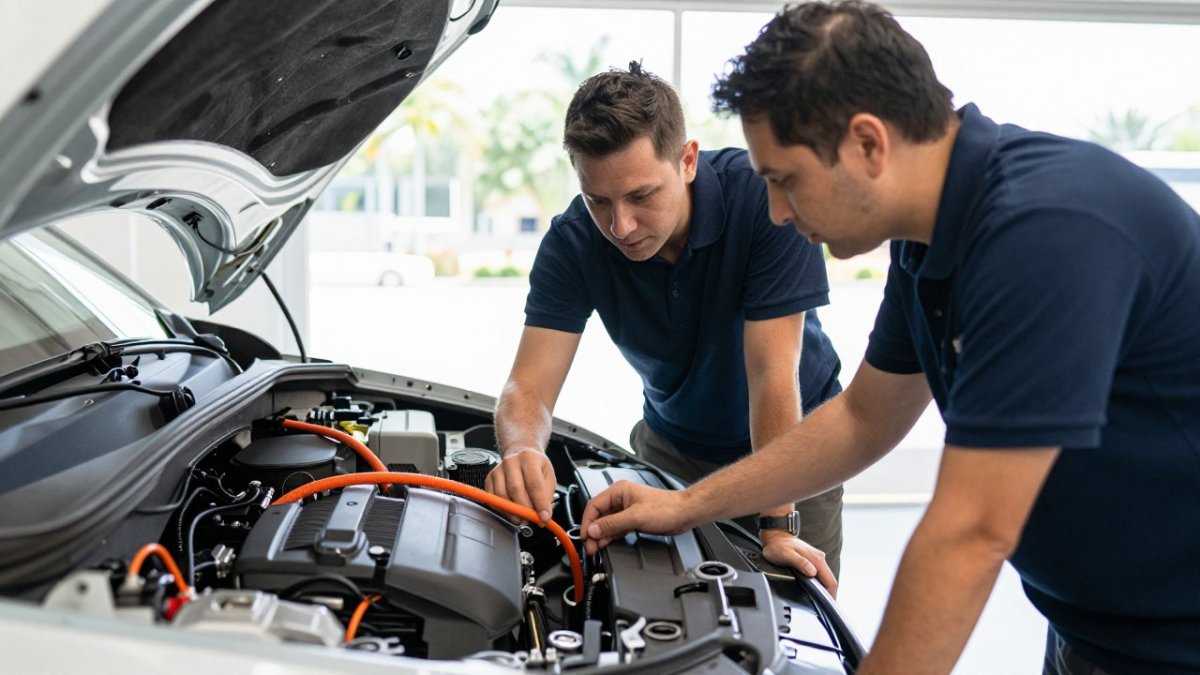
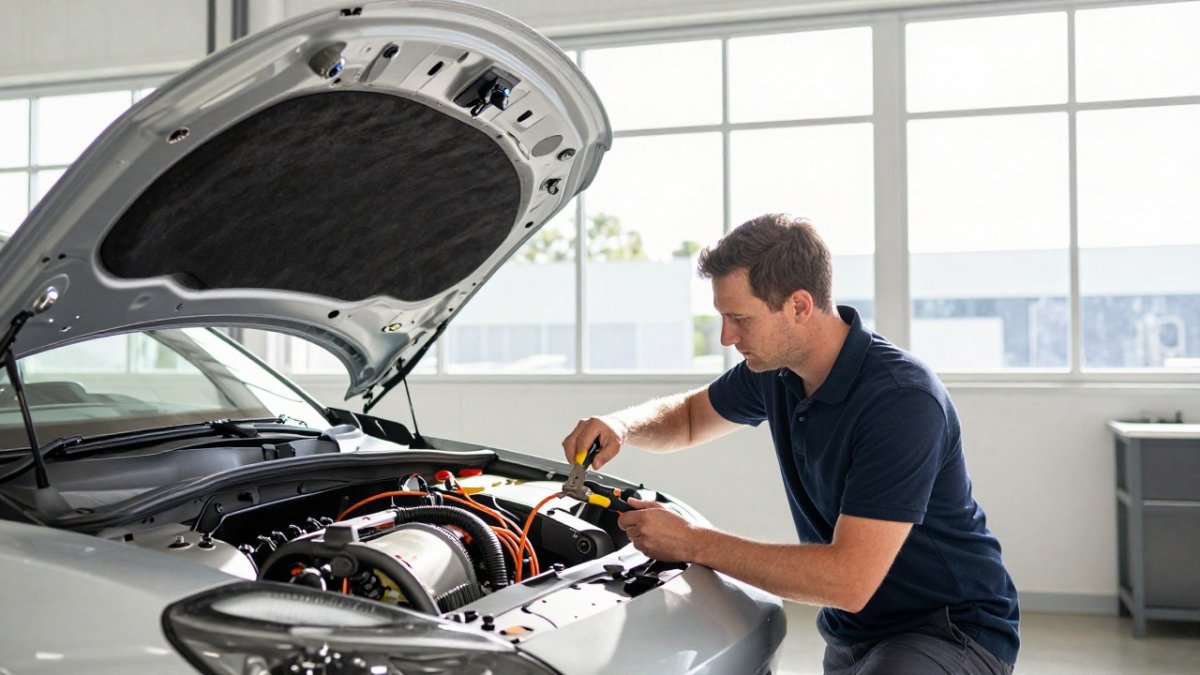
Electric vehicles also use heat pumps and battery thermal management in many models. These systems can share refrigerant circuits with the cabin, so one fault can affect both comfort and battery temperature.
The table below summarises the main differences technicians need to understand.
| Feature | Petrol or Diesel Vehicle | Electric Vehicle |
|---|---|---|
| Compressor drive | Belt driven by engine | Electric, powered by high-voltage battery |
| Refrigerant work | Standard recovery and recharge | Same refrigerant skills, but more connected circuits |
| High-voltage risk | Low, mainly 12-volt systems | High, orange cabling and battery packs |
| Extra training needed | General automotive electrical | High-voltage safety and EV-specific procedures |
| Heat source | Engine waste heat | Heat pump or electric heater |
We recommend treating every EV air conditioning job as a combined task. Refrigerant skills cover the gas. High-voltage training covers the electrical isolation and safe handling of the battery system.
ARC Refrigerant Handling Licence for EVs: Who Needs It and Why
The Australian Refrigeration Council (ARC) issues refrigerant handling licences in Australia (Licence Types). Anyone who recovers or handles refrigerant in an EV air conditioning system generally needs this automotive hvac licence, the same as for a petrol or diesel vehicle.
Check the current licence categories on the official Australian Refrigeration Council site, as requirements can change.
The licence covers refrigerant. It does not cover high-voltage electrical work on the vehicle. Treat the two as separate qualifications that often apply to the same job.
Our nationally accredited automotive air conditioning course guide walks through refrigerant handling licence requirements and course durations, which can help you plan your path.
High Voltage Safety Training for Mechanics and Where the Work Boundary Sits
High-voltage safety training teaches you how to de-energise a vehicle, verify that it is safe, and protect yourself from electric shock. These skills are essential before touching any orange cabling, battery module or inverter.
The work boundary is important. A refrigerant technician can usually handle pipework and service ports, but must stop when a task requires opening high-voltage components or disconnecting battery cables. At that point, the job needs a qualified high-voltage technician.
The boundary is easier to apply when you break it into the sequence a real job follows:
- Confirm the vehicle and the system. Identify whether the refrigerant circuit is shared with battery thermal management. Shared circuits are common on heat-pump models and change the isolation steps.
- Isolate before you open anything. Follow the manufacturer's de-energisation procedure, then verify absence of voltage with a meter you have proven on a known live source. Do not rely on the dash display or a key-off state.
- Stay outside the high-voltage envelope for refrigerant-only tasks. Recovery, recycling, leak detection and recharge on the low-pressure side normally sit outside the high-voltage envelope, provided you have not breached a pack or inverter enclosure.
- Hand over when the task crosses the line. Compressor replacement, inverter work, pack removal and any task requiring an orange cable to be disconnected belong with a technician who holds the relevant high-voltage authorisation.
- Record what you did and what you did not do. A short job note stating the isolation status and the tasks referred onward protects both you and the customer.
Where the line sits varies by jurisdiction. Electrical licensing is administered by state and territory regulators, and the wording of licences and high-voltage authorisations can differ between them. Because the detail changes, verify the current position with your state or territory electrical regulator and with the manufacturer's service information before you accept the job.
Our EV training courses guide compares skill sets and qualifications for electric vehicle technicians. You can also read our modern vehicle electronic systems training guide for more on diagnostics and high-voltage safety.
Review current electrical safety guidance from the relevant Australian regulators before you take on any high-voltage task.
Watch out: the most common failure is treating an EV air conditioning job as "just air conditioning" because the refrigerant side looks familiar. If the task list includes a compressor swap or a shared thermal-management circuit, assume high-voltage isolation applies until you have confirmed otherwise in writing.
Licensing Decision Path for Existing Automotive Air Conditioning Technicians
If you already work as an automotive air conditioning technician, use this simple path to decide what you need next:
- Do you hold a current refrigerant handling licence? If not, get one before handling any refrigerant.
- Does your work involve only the refrigerant circuit and pipework? Your existing skills and licence may cover it.
- Does the job involve battery packs, orange cabling or inverters? Stop and arrange high-voltage training first.
- Are you unsure whether a task crosses the boundary? Refer it to a qualified high-voltage technician.
Many experienced technicians find that short upgrade courses fill the gap. Start with a clear inventory of the tasks you do each week, then match each one to the right qualification.
Choosing Your Next Step: Training Pathways at Swann College
Swann College is a Registered Training Organisation delivering nationally accredited automotive training. Our courses run at campuses in Adelaide and Sydney, and our workshop reflects a real workplace setting. Our curriculum is developed in association with the Institute of Automotive Mechanical Engineers.
Our trainers and staff are supportive and can help you consider a training pathway that fits your goals.
Ready to take the next step? Check the course details and submit your Enrolment Form to start planning your pathway.
Frequently Asked Questions
Does an automotive air conditioning licence cover work on electric vehicles?
A standard automotive air conditioning qualification covers refrigerant handling and cooling system service, which applies to many EVs. It does not, on its own, authorise work on high-voltage EV electrical systems, such as battery packs, inverters and orange cabling. Those tasks need separate high-voltage training and an appropriate electrical authorisation. Before accepting EV work, confirm with your training provider or employer exactly which tasks your qualification and licences cover.
Do EV technicians need an ARC refrigerant handling licence?
Yes, if the work involves recovering, recycling or charging refrigerant in an EV air conditioning circuit. The Australian Refrigeration Council (ARC) licence is required for handling refrigerants under Australian regulations, regardless of whether the vehicle is electric or petrol. The ARC licence covers refrigerant handling only. It does not allow you to work on high-voltage components, so EV technicians often need both refrigerant handling and high-voltage training.
Can a mechanic service an electric vehicle's air conditioning system?
A mechanic can service the refrigerant side of an EV air conditioning system if they hold the required refrigerant handling licence and are trained on the vehicle's cooling architecture. Many EV climate systems use electric compressors powered by the high-voltage battery, so isolating and making the system safe must be done before any hands-on work. Where the job requires access to high-voltage components, refer it to a technician with high-voltage authorisation.
What training do mechanics need before working on electric vehicles?
Mechanics typically need a vocational qualification in automotive technology, refrigerant handling training where air conditioning work is involved, and specific high-voltage safety training for EV systems. Training should cover isolation procedures, insulated tools, personal protective equipment and recognising when to stop work. Check that any course is nationally recognised and includes practical assessment on EV platforms, not only theory.