 Comparison
Hands-On Automotive Training vs Theory: Which Works?
Table of Contents
- Hands-On Automotive Training vs Theory: The Short Answer
- Theory vs Practice Compared: Where Each One Wins
- Why Practical Automotive Training Does the Heavy Lifting
- What Automotive Diagnostic Training Adds to the Mix
- How Automotive Apprenticeship Training Blends Both
- What to Check in an Automotive Mechanic Course
- Conclusion
- Frequently Asked Questions
Last Updated: October 21, 2026
Hands-On Automotive Training vs Theory: The Short Answer
Hands-on automotive training wins on job readiness, but only on a solid base of theory. Students who work all day under a bonnet without understanding why a circuit fails become parts-fitters, not diagnosticians.
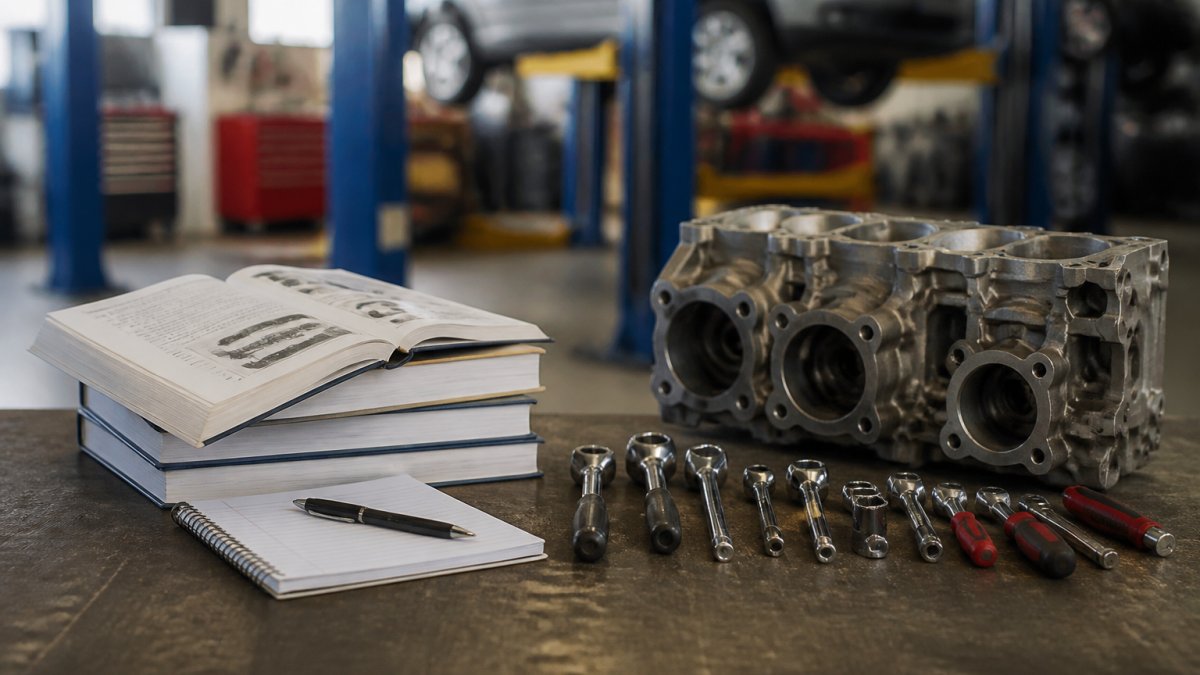
The practical side develops feel, speed and confidence with real vehicles, tools and diagnostic equipment. The theory side builds the reasoning to diagnose a fault never seen before. Neither works alone.
What Each Approach Actually Delivers
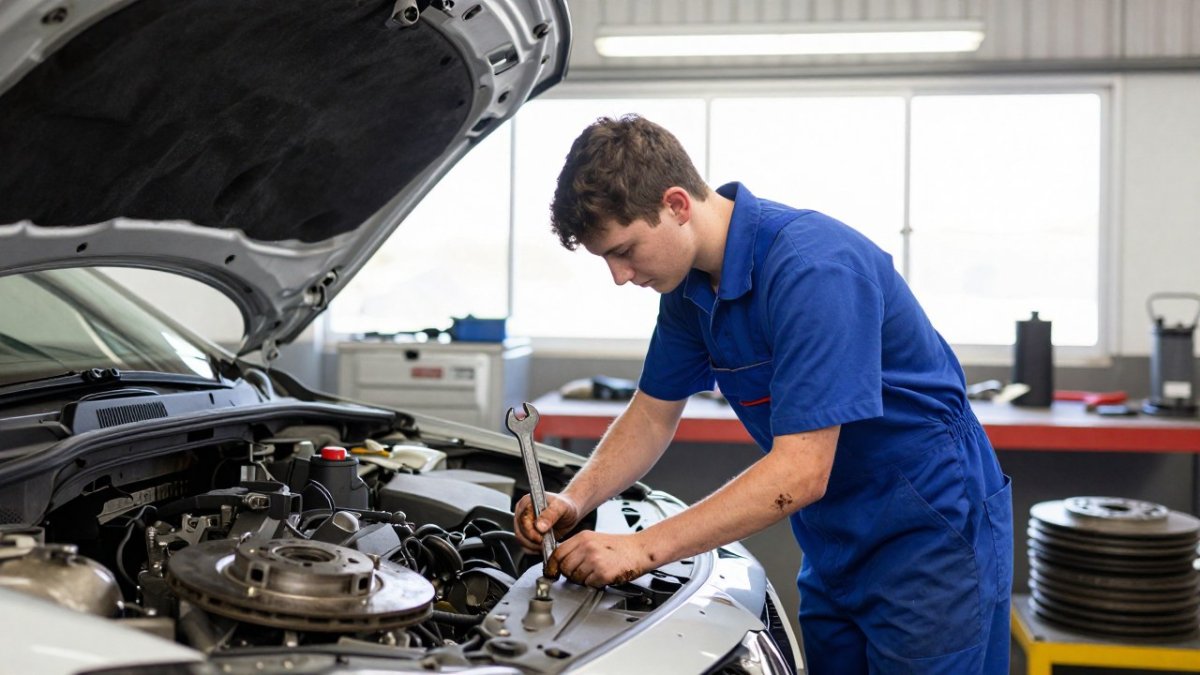
Hands-on automotive training is instruction through direct work on vehicles and equipment: removing components, testing circuits, reading live data and completing repairs under supervision.
Theory-led learning covers vehicle systems, electrical principles, diagnostic logic and safety requirements. It is slower and less exciting, but it gives a technician the mental model to interpret scan tool data.
The real difference shows up in unfamiliar situations. A theory-only learner can recite how a charging system works but freezes at the vehicle.
Theory vs Practice Compared: Where Each One Wins
Theory wins on diagnosis, safety and adaptability; practice wins on speed, confidence and employability. The useful comparison is which carries more weight at each stage and for each repair task.
Side-by-Side Comparison Table
| Factor | Theory-Led Learning | Hands-On Training | Where It Matters Most |
|---|---|---|---|
| Diagnostic reasoning | Strong | Develops with repetition | Complex electrical faults |
| Tool familiarity | Limited | Strong | Daily workshop tasks |
| Safety awareness | Strong in principle | Strong in practice | Hazardous systems, high voltage |
| Confidence on real vehicles | Low | High | First job, first solo repair |
| Adaptability to new technology | Strong | Needs theory support | EV and hybrid systems |
| Job readiness | Partial | Strong when paired with theory | Employer hiring decisions |
A Sample Theory-to-Practice Sequence
A well-built course sequences theory and practice so each classroom concept is followed quickly by a workshop task that uses it:
- Vehicle systems overview (theory, week 1). Classroom sessions cover how engines, braking, steering and electrical systems work as systems, not lists of parts. Assessment is a written and diagram-based test.
- Hand tool and workshop safety induction (practical, week 1-2). Students learn tool identification, torque wrench use, lifting and jacking procedures, and workshop housekeeping. Assessment is a supervised practical demonstration.
- Battery, starting and charging (theory then practical, week 3). A classroom session on voltage, current and circuit behaviour is followed by a workshop task: perform a battery load test, check voltage drop on the starter circuit and test alternator output. Assessment combines a short written quiz with a practical task checklist.
- Braking systems (theory then practical, week 4-5). Theory covers hydraulic principles and friction materials. Workshop tasks include measuring brake pads and discs against specification, bleeding a hydraulic circuit and inspecting a brake booster. Assessment is a practical task with a safety check.
- Engine management and diagnostics (theory then practical, week 6-8). Theory covers sensor operation, fuel trim and scan tool data. Workshop tasks include retrieving fault codes, reading live data and back-probing a sensor circuit. Assessment is a diagnostic scenario where the student must find a planted fault and explain the reasoning.
- Routine servicing and workplace simulation (practical, week 9-10). Students complete a full service to a checklist under time pressure, including fluid checks, filter replacement, tyre inspection and a written handover note. Assessment is a practical demonstration plus a short written report.
Theory carries the early load when students need a mental model; practice carries the middle and later load when they apply it under supervision. The final workplace simulation shows employers whether both have stuck.
How Training Methods Differ by Repair Task
Not every repair task rewards the same training method.
- Routine maintenance (servicing, fluids, filters, tyres). Practice-heavy. These tasks reward repetition, cleanliness and speed. Theory matters mainly for specifications and safety.
- Brake and suspension work. Mixed, leaning practical. Theory explains hydraulic principles and friction, but the skill is in measurement, feel and correct torque. Supervised repetition is essential.
- Electrical and electronic systems. Theory-heavy at first. Students need to understand voltage, current, resistance and circuit design before they can interpret a wiring diagram. Practical work then confirms the theory through voltage drop tests and circuit loading.
Assessment Methods That Actually Measure Competence
A credible comparison has to look at assessment, not just teaching. Written tests measure recall and reasoning; practical demonstrations measure capability. The strongest courses use both, plus diagnostic accuracy on real or realistic faults.
| Assessment Method | What It Measures | Where It Falls Short Alone |
|---|---|---|
| Written tests and quizzes | Recall of systems, specifications and safety rules | Does not prove the student can perform the task |
| Practical task checklists | Ability to complete a defined task to standard | Can reward following steps without understanding why |
| Diagnostic scenarios | Reasoning from symptom to root cause | Time-consuming to run at scale |
| Safety assessments | Awareness of hazards and correct procedures | Does not measure repair skill |
| Workplace simulation | Time management, handover and job readiness | Depends on the realism of the setup |
A course assessed only on paper is probably mostly theoretical; one assessed only on practical tasks may produce technicians who follow steps but cannot explain a fault.
Cost, Time and Access to Equipment
Classroom-heavy delivery is cheaper per hour to run but does not build capability on its own. Workshop-heavy delivery requires vehicles, hoists, diagnostic equipment and lower student-to-vehicle ratios, so practical courses typically cost more and run longer.
Ask for a full breakdown rather than a headline figure: tuition, consumables, tools, protective equipment and additional certifications. Ask how many students share a vehicle, how many workshop hours are scheduled, and whether the course uses real vehicles with real faults or simulators.
Why Practical Automotive Training Does the Heavy Lifting
Practical automotive training carries most of the weight because employers assess what a technician can do, not what they can recall.
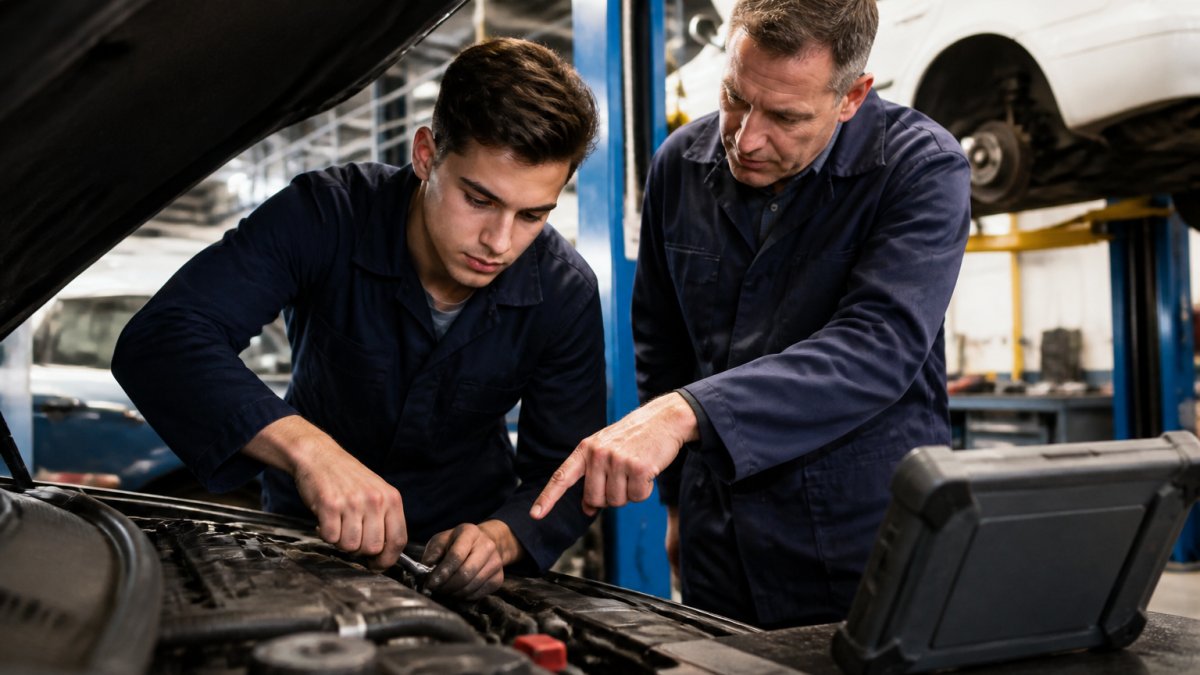
Students who work on real vehicles with real repair equipment learn how components behave under load and how faults present in practice rather than on a slide.
That said, practical work without theory has a ceiling. A student who can complete a task but cannot explain why it worked will struggle the moment the task changes.
What Automotive Diagnostic Training Adds to the Mix
Automotive diagnostic training is the clearest example of theory and practice needing each other, and where the choice of training method has the biggest effect on what a student can actually do.
Modern vehicles run dozens of control modules, and a fault code rarely names the failed part, it names a circuit or system. Interpreting it requires theory: voltage drops, signal patterns and module communication.
How Diagnostic Training Differs by Vehicle System
Diagnostic work splits into areas that reward different training methods; teaching them all the same way leaves gaps.
- Engine management and drivability. Theory-heavy at the start. Students need to understand fuel trim, sensor operation and how the engine control module makes decisions before scan tool data means anything. Practical work then confirms the theory through live data comparison and circuit testing.
- Electrical and charging systems. The most theory-dependent area. Voltage drop, resistance and circuit design must be understood before a student can trace a fault through a wiring diagram. Practical work is essential for confirming the fault, but it cannot replace the reasoning.
- Braking, steering and suspension. Practice-heavy. Diagnostics here is often measurement and inspection rather than circuit reasoning. Repetition and feel matter more than classroom depth.
What Diagnostic Competence Looks Like When It Is Assessed Properly
A diagnostic course is only as good as how it assesses diagnostic skill. Written tests measure whether a student knows the theory of a circuit, not whether they can find a fault on a vehicle. The strongest courses combine methods:
- Planted-fault scenarios. The student is given a vehicle or rig with a known fault and must find it, confirm it and explain the reasoning. This is the closest thing to real diagnostic work.
- Live data interpretation. The student is shown scan tool data and asked to explain what it means and what to test next.
- Wiring diagram exercises. The student traces a circuit and identifies likely failure points.
A course assessing diagnostics only through multiple-choice questions is teaching theory, not diagnostics; one assessing only practical tasks may produce students who follow a test procedure but cannot reason through an unfamiliar fault.
The Limits of Each Approach in Diagnostics
Theory-only training produces students who can explain a circuit but freeze at the vehicle; practical-only training produces students who can swap parts but struggle with intermittent or unfamiliar faults. The blended model is the only one that produces a technician who can both reason and confirm, which is why the best diagnostic courses sequence theory and practice tightly, assess both, and use real vehicles with real faults rather than simulations alone.
How Automotive Apprenticeship Training Blends Both
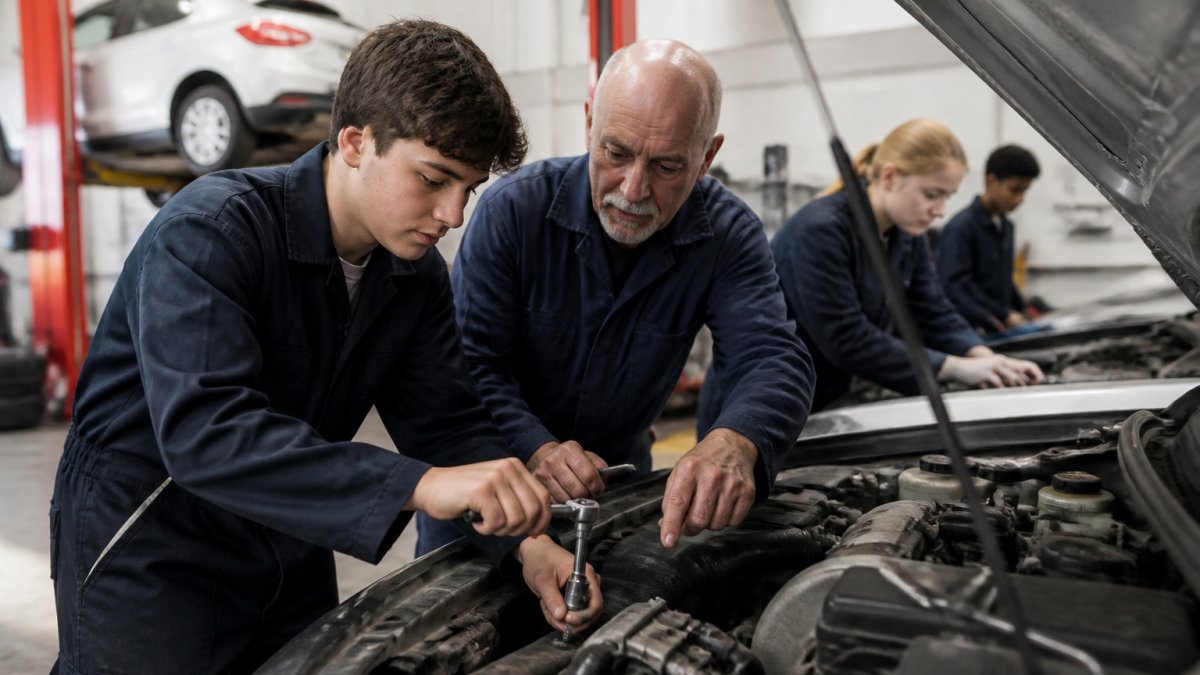
Automotive apprenticeship training gets the blend right by design. Apprentices spend most of their week in a workshop applying skills and study theory in structured blocks alongside it.
The weakness is that workshop placement quality varies: an apprentice in a busy, well-run workshop sees many repair tasks, while one in a quiet shop may spend months on routine servicing.
At Swann College, our workshop training facility is set up to reflect a real workplace, so students practise in conditions that match what they will meet on the job.
What to Check in an Automotive Mechanic Course
An automotive mechanic course is only as good as its balance of workshop hours, theory depth and assessment rigour. Check these before you enrol.
- Workshop access: real vehicles, hoists and diagnostic equipment, with a workable student-to-vehicle ratio
- Theory depth: vehicle systems, electrical principles and diagnostic logic taught as reasoning, not memorisation
- Assessment method: practical tasks assessed on the vehicle, not just written tests
On cost, ask for a full breakdown rather than a headline figure: tuition, consumables, tools and additional certifications all add up, and the cheapest advertised course is rarely the cheapest once everything is included. Payment plans and government funding eligibility vary, so confirm what applies to you with the provider.
Conclusion
Choosing between hands-on automotive training and theory is the wrong question, and courses that treat it as a binary are the ones to avoid.
At Swann College, we deliver nationally accredited automotive training built around exactly that model: a workshop facility that mirrors a real workplace, small-group practical work on real vehicles, and theory taught to explain the job rather than replace it.
If you are ready to train where the practical and the theoretical meet, get started with Swann College and build the skills employers actually check for.
Frequently Asked Questions
What is the difference between hands-on automotive training and theory?
Theory covers how vehicle systems work: engine operation, electrical circuits, hydraulic braking, and diagnostic logic. Hands-on automotive training puts that knowledge into practice on real vehicles, using tools, repair equipment and diagnostic equipment in a workshop. Theory alone leaves you unable to complete repair tasks; practice alone leaves you guessing when a fault does not match the textbook case. Nationally accredited courses combine classroom instruction with guided practice so each reinforces the other, which is why employers look for both when hiring.
Can you learn automotive repair from theory alone?
No. Theory explains why a system fails, but vehicle maintenance and troubleshooting require physical skill: reading a scan tool, testing a circuit, torquing a component to spec. Employers hiring an automotive technician expect job readiness from day one, which means familiarity with real vehicles and repair equipment. Online training and self-teaching can build foundational knowledge, but they cannot replace supervised workshop time. A course that offers only classroom instruction will leave gaps when you face an actual vehicle.
How does automotive diagnostic training fit into a practical course?
Automotive diagnostic training teaches you to interpret fault codes, use diagnostic equipment, and follow a logical test sequence rather than replacing parts by guesswork. Modern vehicles rely on networked electronic systems, so this skill is now central to the trade. The strongest courses pair diagnostic theory with live fault-finding on real vehicles under instructor supervision. Ask any provider how much time you spend with a scan tool in hand, because watching a demonstration is not the same as diagnosing a fault yourself.
What should I look for in an automotive mechanic course?
Check four things: national accreditation, workshop facilities, instructor industry experience, and time on real vehicles. A Registered Training Organisation delivering nationally accredited courses gives you a qualification employers recognise. A workshop that mirrors a real workplace matters more than glossy brochures. Experienced instructors who have worked in the trade can explain the shortcuts and common mistakes that textbooks miss. Finally, ask what proportion of the automotive mechanic course is guided practice versus classroom instruction, and whether mentorship continues through automotive apprenticeship training.