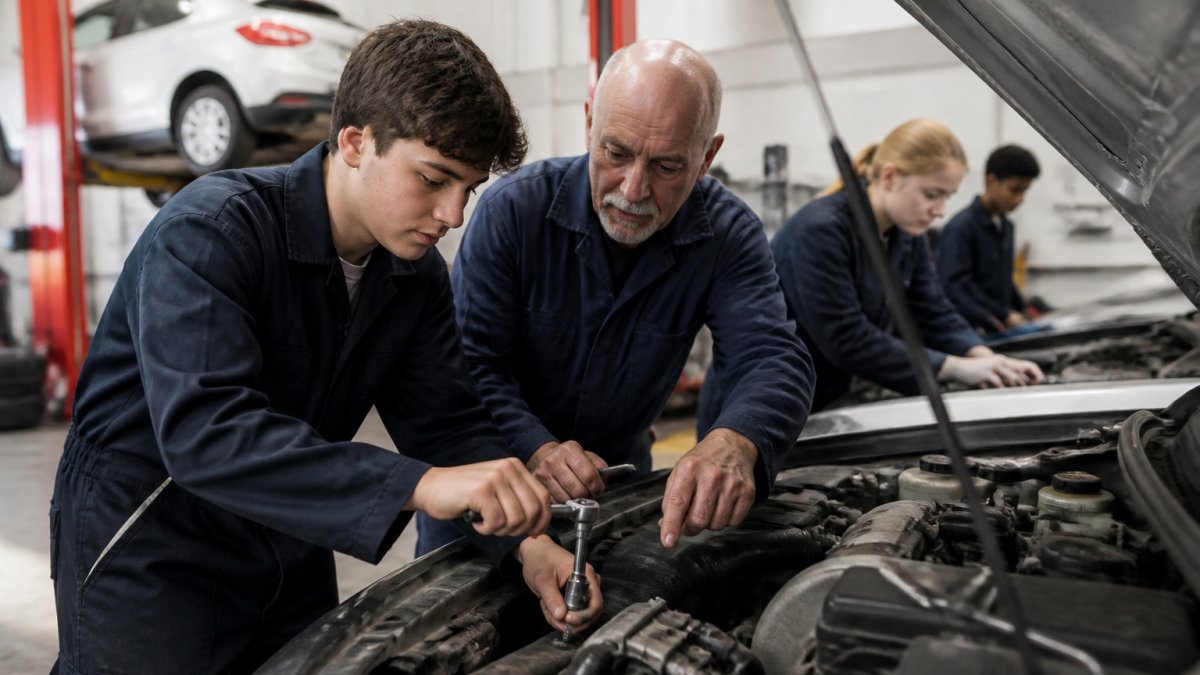
 Comparison
Hands-On Workshop Training vs Online Theory for Mechanics
Last Updated: November 10, 2026
Quick Summary
Hands-on workshop training builds the physical and diagnostic skills employers hire for, while online theory builds the knowledge that makes those skills safe and useful. Most learners do best with a blended pathway that combines both. Beginners should lean toward workshop-heavy study, while experienced technicians may need only targeted short courses.
- Workshop training develops tool use, torque application and hands-on diagnostics on real vehicles.
- Online theory suits electrical principles, safety rules, workshop procedures and terminology.
- Beginners with no trade experience should start workshop-heavy, with theory added for support.
- Employers look for observed practical tasks and workplace evidence, not just course completion certificates.
- Confirm that practical units are assessed in a workshop meeting the unit's equipment requirements.
Table of Contents
- Workshop Training vs Online Theory: Which Suits Your Goal?
- What Hands-On Workshop Training Develops
- What Online Theory Does Well and Where It Falls Short
- Which Automotive Skills Can and Cannot Be Learned Online
- Comparing Options by Experience Level and Learner Goal
- Automotive Apprenticeship Requirements and Training Pathways
- AUR Automotive Training Packages and Blended Learning
- Choosing Your Next Step at Swann College
- Frequently Asked Questions
Choosing between hands-on workshop training and online theory is one of the first decisions a mechanic-in-training makes, and it shapes how quickly you become job-ready. You can compare how each builds skills and what a blended course looks like before you decide.
Our recommendation is a blended pathway for most learners. Theory explains why a fault occurs. Workshop time shows you how to find it on a real vehicle.
Workshop Training vs Online Theory: Which Suits Your Goal?
Workshop training suits anyone who needs to handle tools, inspect vehicles and build diagnostic habits. Online theory suits learners who need flexibility, cannot attend full-time, or want to revise technical content at their own pace.
If you have been out of the trade for several years, workshop time matters more. Your hands need to relearn torque values, fastener feel and safe lifting habits.
What Hands-On Workshop Training Develops
Workshop training builds the physical and diagnostic skills that theory alone cannot deliver. Our step-by-step guide covers workshop safety, tools and diagnostics for students who want to start building these skills.
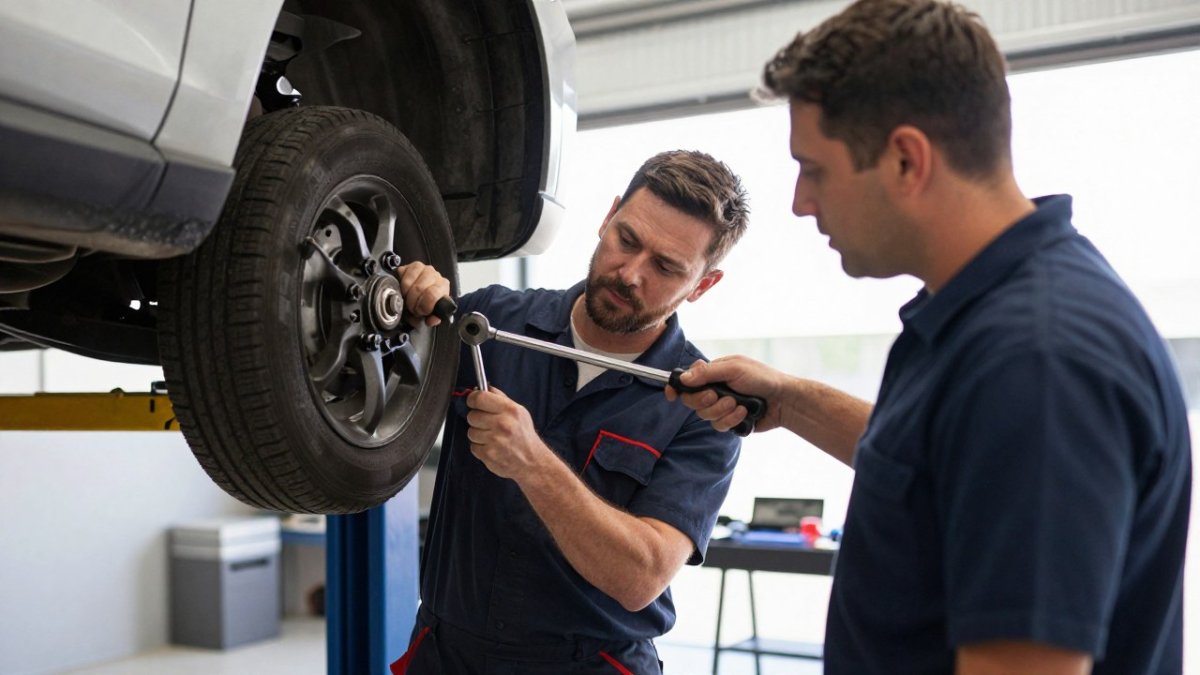
Practical learning also builds judgement. A textbook will tell you a sensor can fail. A workshop shows you how a fault looks, sounds and behaves under load, and how to confirm it before replacing parts.
Fault diagnosis and tools on real vehicles
Diagnosis is where workshop time earns its keep. On real vehicles you practise a sequence: confirm the complaint, scan for codes, test the circuit, then verify the repair. You can see how workshop training delivers inspections, servicing and diagnosis in practice.
Many learners find the first few faults slow going. That is normal. Speed comes from repetition, and repetition is what a supervised workshop provides.
Practical assessment and proof of competency
Workshop training also gives you something a certificate alone cannot: demonstrated competency. Practical assessment asks you to complete tasks to a set standard, which gives employers evidence that you can do the work, not just pass a quiz.
What Online Theory Does Well and Where It Falls Short
Online theory does well at the content that does not need a vehicle in front of you.
Its limits are just as clear. Theory cannot teach you how a bolt should feel when it reaches its torque specification, or how to spot a fault that only appears under load.
Our view is that online study works best as preparation and reinforcement, not as a replacement for supervised practice.
Which Automotive Skills Can and Cannot Be Learned Online
Some automotive skills can be learned effectively online, and others cannot. Understanding the split helps you decide what to study remotely and what to do in person.
- Can be learned online: vehicle systems theory, electrical principles, safety rules, workshop procedures, reading service information and terminology.
- Best learned in a workshop: using hand and power tools, torque application, removing and refitting components, hands-on diagnostics, and working with live vehicles.
- Needs both: fault finding, which requires theory to understand the fault and practice to locate it.
Modern vehicles add more complexity, particularly hybrid and electric systems that carry high-voltage risks, which call for supervised practical training.
Comparing Options by Experience Level and Learner Goal
The right choice depends on who you are, what you already know, and what you need next. A general comparison of practical versus online study is not much help on its own, so use the breakdown below to locate yourself and work from there.
Complete beginner with no trade experience
Start workshop-heavy. Beginners need supervised time with tools, lifting equipment and live vehicles before theory has anything to attach to. Online theory is useful for revising safety rules, tool names and basic systems, but it should not be the main delivery mode at this stage.
- Time commitment: this varies by course, so ask us for the schedule.
- Cost drivers: course fees and any equipment you must supply. Pricing depends on the course, so please check our website or request a quote.
- What to check: how practical units are assessed before you enrol.
Career changer with general mechanical knowledge
Blended delivery usually fits best. You may already understand fasteners, hand tools and basic maintenance from another trade or hobby, so targeted theory fills the gaps while workshop sessions build automotive-specific habits such as diagnostic sequence and safe high-voltage handling. Ask the provider which units are delivered online and which require attendance, because the split varies between courses.
- Time commitment: this depends on your prior learning and the course you choose.
- Cost drivers: ask us for current fees, as pricing depends on the course and your circumstances.
- What to check: how practical assessment is conducted against the relevant unit of competency.
Experienced technician upskilling
Working technicians rarely need another full qualification. They need short, targeted training in a specific area, automotive air conditioning, EV and hybrid high-voltage systems, advanced driver-assistance systems calibration, or diagnostic software. Online theory works well for the knowledge component, but the practical component must be supervised, particularly for anything involving high voltage.
- Time commitment: days to weeks per short course, not months.
- Cost drivers: course fees, time away from the workshop, and any tooling or software licences.
- What to check: that the trainer holds current industry experience and that the workshop equipment matches the vehicles you actually work on.
Mobile mechanic upgrading qualifications
If you already run a mobile business but lack formal qualifications, a blended pathway with practical sessions on current vehicle technology is usually the most efficient route. The theory can be studied around jobs, and workshop days can be scheduled in blocks.
- Time commitment: variable, often built around existing work.
- Cost drivers: tuition, travel, and lost billable hours during attendance.
- What to check: that the qualification is nationally recognised and that assessment evidence is portable to your state's requirements.
How to weigh the trade-offs
When comparing formats, put a number on the hidden costs as well as the visible ones. Tuition is only part of the picture.
Ask for the full schedule and a list of what you must supply before you enrol. You can also browse our short course options for your experience level and goal.
Quick decision guide
- No experience, want to be job-ready: workshop-heavy with foundation theory.
- Some mechanical background, changing careers: blended with recognition of prior learning where possible.
- Already working, need one skill: targeted short course with supervised practical assessment.
If you are unsure where you sit, the safest starting point is a conversation with a provider about your current skills and your goal, rather than picking a format from a brochure.
The right format depends on your experience and goal, so the table below sets out the main starting points and what each one suggests.
| Learner situation | Suggested approach | Key point |
|---|---|---|
| Complete beginner, no trade experience | Workshop-heavy | Needs supervised tools and live vehicles first |
| Career changer, general mechanical knowledge | Blended | Theory fills gaps, workshop builds automotive habits |
| Experienced technician upskilling | Targeted short course | Practical component must be supervised |
| Mobile mechanic upgrading qualifications | Blended, scheduled around jobs | Confirm the qualification is nationally recognised |
Automotive Apprenticeship Requirements and Training Pathways
If you plan to become a mechanic through an apprenticeship, workshop training usually forms the core of the pathway. The structure is set by the national training system, but the practical arrangements, including how you are employed, supervised and assessed, vary by state, territory and employer. That is why the same qualification can feel very different depending on where you do it.
What an apprenticeship actually involves
An apprenticeship combines paid employment with structured training. For a full overview, read our guide on how to become a mechanic in Australia.
A pre-apprenticeship course can be an entry route. It gives you foundation skills and a taste of workshop practice before you apply for an apprenticeship, which can make you a stronger candidate when employers are choosing between applicants.
The competency evidence employers look for
Employers are not just checking that you passed a quiz. They want evidence that you can perform tasks to a workplace standard. In practice, that means:
- Observed practical tasks: an assessor watches you complete a job on a vehicle and confirms you met the performance criteria.
- Workplace evidence: logbooks, job records or supervisor reports showing what you have done on the job.
- Knowledge assessment: written or online tests that confirm you understand the theory behind the task.
A certificate of completion from an online course is not the same as this evidence. It shows you finished the content; it does not show you can do the work. That distinction matters when you apply for jobs or seek recognition of your skills.
How pathways differ
There is more than one route into the trade, and the right one depends on your circumstances:
- Australian Apprenticeship: the standard pathway, combining paid work with training. Suits school leavers and career changers who can commit to a full-time arrangement.
- Pre-apprenticeship: a shorter course that builds foundation skills and improves your chances of securing an apprenticeship.
- School-based apprenticeship or traineeship: lets you start training while still at school, usually in a reduced capacity.
Each pathway leads to a nationally recognised qualification, but the time, cost and evidence requirements differ. Ask the RTO how each unit is assessed and whether workplace evidence can count towards completion.
What to confirm before you enrol
Before committing to any pathway, confirm the following with the provider and, where relevant, your state or territory training authority:
- The qualification is nationally recognised and delivered by a registered training organisation.
- Practical units are assessed in a real or simulated workshop that meets the equipment requirements of the unit.
- The trainer holds current industry experience and the relevant assessment credentials.
Watch out: apprenticeship requirements and funding arrangements change, and they are not identical across states and territories, so confirm the current rules with your training authority rather than relying on a course brochure.
How this connects to your training choice
If your goal is an apprenticeship, workshop training is not optional, it is the evidence base employers and assessors rely on. Online theory supports that evidence by giving you the knowledge to understand what you are doing, but it cannot replace the observed practical tasks that prove competency. That is why a blended pathway, with theory delivered flexibly and practical units completed under supervision, aligns most closely with how apprenticeships are structured.
AUR Automotive Training Packages and Blended Learning
Automotive training in Australia is delivered under nationally recognised training packages, which set out the units of competency a qualification must cover. Units cover both knowledge and practical performance, so a sound course needs both components.
Blended learning brings the two together. Theory is delivered online or in class, and practical units are completed in the workshop. This structure lets you study around work or family commitments while still building the hands-on skills assessors look for.
Choosing Your Next Step at Swann College
If you want practical skills with theory that supports them, a blended pathway at Swann College is a strong place to start.
Start by deciding your goal: a full qualification, an apprenticeship pathway, or a short course in a specific skill. Then talk to our team about which format fits your schedule and experience.
Frequently Asked Questions
Can you become a qualified mechanic through online training alone?
Online theory can build the knowledge behind automotive work, but nationally accredited vocational qualifications in Australia require assessed practical competency. Most automotive training packages include workshop components where you demonstrate tasks such as fault diagnosis, repair procedures and tool use on real vehicles or equipment. Before enrolling, check whether a course includes supervised practical assessment, and ask the provider how that assessment is delivered and recorded. Swann College's workshop environment is designed to mirror a real workplace.
Are online automotive courses recognised by Australian employers?
Employers generally look for nationally recognised qualifications and evidence that you can do the work. A course delivered by a Registered Training Organisation carries national recognition, but the value of a qualification depends on how much practical competence it demonstrates. Purely online study without hands-on assessment may not give employers the confidence they need for workshop roles. Blended delivery, which combines online theory with workshop practice, is often the stronger option for job readiness.
What is the difference between a certificate and a practical trade qualification?
A certificate is a formal credential issued after a course is completed and assessed against a training package. A practical trade qualification, such as one linked to an apprenticeship, combines structured training with supervised work experience in a workplace. Certificates can be completed in a training environment alone, while trade qualifications typically require documented on-the-job hours. Check the course description to see which requirements apply before you enrol.
How does Swann College integrate practical training with theoretical learning?
Swann College delivers its automotive training in a workshop environment designed to reflect a real workplace, with curriculum developed in association with the Institute of Automotive Mechanical Engineers. Theory is taught to explain the systems and principles behind each task, Contact Swann College directly for details of how a specific course is structured and for current pricing.