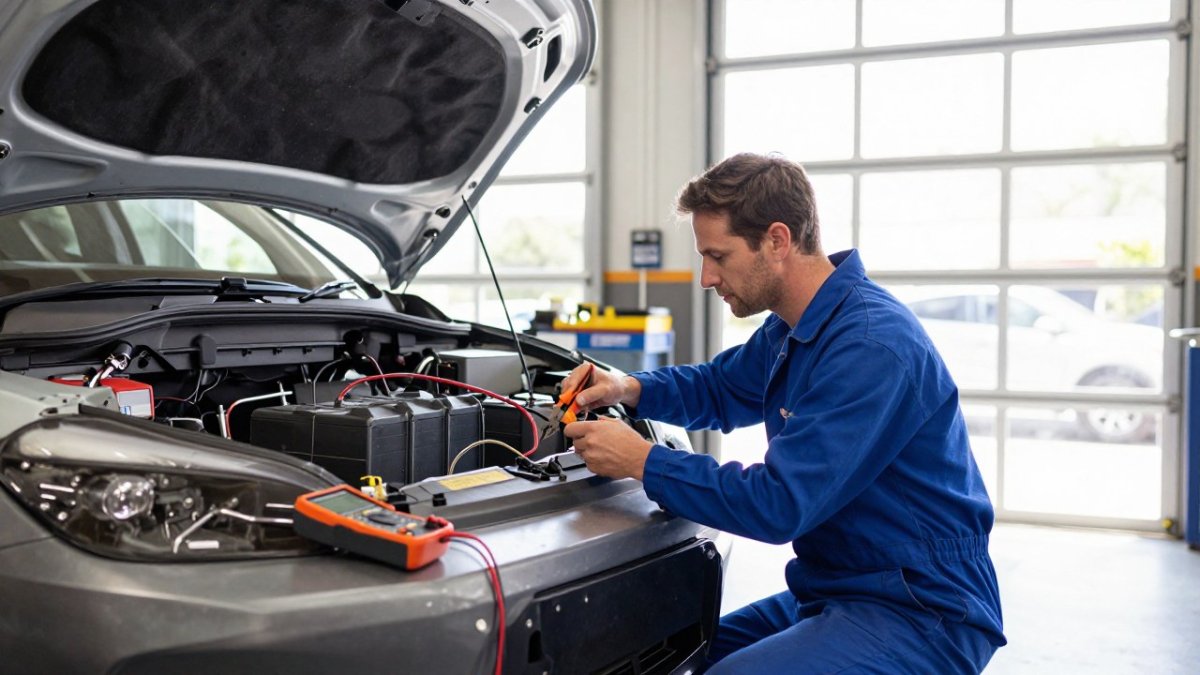
 Ultimate guide
Modern Vehicle Electronic Systems Training: 2026 Guide
Table of Contents
- What Modern Vehicle Electronic Systems Training Covers
- Automotive Electrical Systems Training: The Core Skills
- Vehicle Electronics Diagnostics Training: Reading Faults Accurately
- High-Voltage Safety Training for Mechanics: Non-Negotiable
- Electric Vehicle Technician Training: Working on Hybrids and BEVs
- How to Choose a Modern Vehicle Electronic Systems Course
- Frequently Asked Questions
Last Updated: October 18, 2026
What Modern Vehicle Electronic Systems Training Covers
Modern vehicle electronic systems training teaches technicians to diagnose, service and repair the networked computers, sensors and high-voltage hardware found in today's cars, from conventional petrol models through to hybrids and battery-electric vehicles. At Swann College, our automotive electrical systems training covers the full stack: signal inputs, control units, wiring diagnosis and the safety procedures that govern electric drivetrains.
The scope is broader than most people expect. A modern car runs dozens of electronic control units (ECUs) across multiple communication networks, and a technician who only knows how to read fault codes will hit a wall fast. Training that covers vehicle electronics properly builds three layers of skill at once:
- Electrical fundamentals: voltage, current, resistance, continuity and ground circuits
- Diagnostic method: using multimeters, oscilloscopes and scan tools to trace faults to their source
- System knowledge: how ECUs, sensors and actuators interact across powertrain, body and chassis systems
The Australian Skills Quality Authority regulates vocational training in this field, so a nationally accredited course should map directly to the competencies employers actually test for.
Automotive Electrical Systems Training: The Core Skills
Automotive electrical systems training builds the foundation everything else sits on. Without a working grasp of circuit behaviour, the diagnostic tools are just expensive boxes.
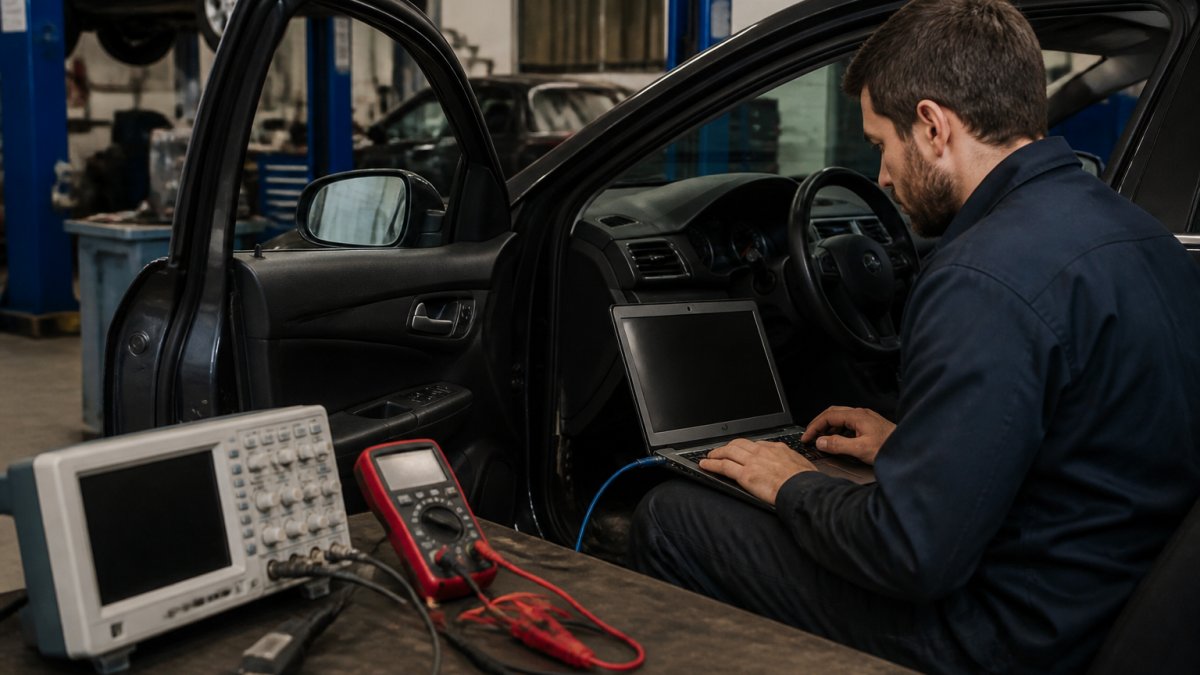
The core skills break down into four areas. First, circuit fundamentals: reading electrical schematics, measuring voltage drops, and understanding how ground circuits cause faults that look like something else entirely. Second, component testing: checking sensors and actuators against their expected signal range. Third, wiring repair: working with a wiring harness, connectors and terminals without introducing new faults. Fourth, data interpretation: knowing what a healthy signal looks like before you go hunting for a bad one.
A common mistake is jumping to the scan tool before checking the basics. A dirty ground or a corroded connector will throw codes that send you chasing a control unit that was never the problem.
From Multimeters to Oscilloscopes: The Tools You'll Master
The multimeter is the entry point. You'll use it for voltage, resistance and continuity checks, and it handles most basic fault-finding. The oscilloscope is where diagnosis gets serious: it shows signal inputs over time, so you can spot an intermittent sensor or a distorted waveform that a multimeter would never reveal.
Scan tools and diagnostic software round out the kit, along with access to electrical schematics for the vehicles you work on. Training should give you hands-on time with each, not just a demonstration.
Vehicle Electronics Diagnostics Training: Reading Faults Accurately
Vehicle electronics diagnostics training teaches a structured process: gather the symptom, check the basics, test the circuit, confirm the repair. The goal is accuracy, not speed, though accuracy is what eventually makes you fast.
Fault diagnosis starts with the complaint and the scan tool data, but neither tells the whole story. A fault code points to a circuit or system, not a failed part. The diagnostic process narrows that down:
- Verify the symptom and reproduce the fault where possible
- Check power, ground and connections at the affected circuit
- Test the sensor or actuator against specification
- Confirm the repair clears the fault and doesn't return
Training that skips circuit testing and goes straight to part-swapping produces technicians who cost workshops money. The Institute of Automotive Mechanical Engineers aligns its guidance with practices that keep diagnosis grounded in evidence.
High-Voltage Safety Training for Mechanics: Non-Negotiable
High-voltage safety training for mechanics is mandatory before anyone works on a hybrid or electric vehicle's traction system. These systems run at voltages that can kill, and the risks don't announce themselves.
Training covers personal protective equipment, safe isolation procedures, lockout and tagging, and the workshop procedures that keep high-voltage work contained. You'll learn to identify high-voltage components and cabling, de-energise a system correctly, and verify that it's safe before touching anything.
The regulatory context matters here. Work health and safety obligations apply to anyone handling hazardous energy, and Safe Work Australia sets out the framework employers and workers must follow. A course that treats high-voltage safety as an afterthought isn't worth the enrolment.
Electric Vehicle Technician Training: Working on Hybrids and BEVs
Electric vehicle technician training extends the electrical foundation into traction systems: the traction motor, power electronics, inverter, battery management system and high-voltage battery. Hybrids add engine management and regenerative braking to the picture, so technicians need fluency in both worlds. The mistake most training makes is treating these as separate subjects.
What actually changes is the energy flow. In a conventional vehicle, the electrical system supports the engine, starting, charging, sensing and control. In a hybrid, the electrical system shares propulsion with the engine, so the inverter, motor-generator and battery management system become part of the drivetrain, and regenerative braking means brake and drivetrain complaints can originate in the energy-recovery path rather than the friction brakes.
That difference shapes diagnosis. On a hybrid, a fault code for a motor-generator circuit may point to the inverter, the cabling or the battery management system, and the diagnostic path has to isolate which.
High-voltage safety is the gate to all of it. Before any traction-system work, a technician needs supervised practice in identifying high-voltage components and cabling, de-energising the system correctly, and verifying that it is safe, including the fact that capacitors can hold charge after isolation. That is why the safety unit should come before the diagnostic units, not alongside them.
A well-sequenced course moves in stages: electrical fundamentals and circuit testing on conventional vehicles, then communication networks and control strategies, then high-voltage safety and isolation, then hybrid and BEV architecture and diagnosis. Each stage assumes the one before it. A technician who jumps straight to battery-electric content without solid circuit-testing skills will struggle to trace a fault through a high-voltage interlock loop or a battery management system signal.
Training should cover conventional, hybrid and battery-electric architectures together, because workshops see all three. A technician who only understands BEVs will struggle the first time a plug-in hybrid rolls in, and a technician who only understands hybrids will be lost on a dedicated EV platform with no engine management to fall back on.
How to Choose a Modern Vehicle Electronic Systems Course
Choosing a modern vehicle electronic systems training course comes down to accreditation, hands-on time and how current the content is. But the market is fragmented, full qualifications, short courses, manufacturer-specific programs and online theory modules all use similar language, so you need a way to compare them on substance rather than marketing.
Start with the credential. In the vocational system, a Registered Training Organisation delivers courses from the national training package, and the resulting qualification is recognised across employers. A short course from a private provider may teach real skills but carry no national recognition, which matters if you ever move between employers or states.
Then compare the practical component. A course can legitimately call itself hands-on while giving you twenty minutes on a diagnostic rig.
Here is how the main options compare on the factors that matter:
| Course type | Best for | Typical credential | Hands-on component | Typical commitment |
|---|---|---|---|---|
| Full qualification (Certificate III/IV in automotive) | Career starters, career-changers, apprentices | Nationally recognised qualification | High, workshop-based, assessed on live vehicles | Months, full or part-time |
| Short-course certification (EV/hybrid safety, air conditioning) | Working technicians adding a specific skill | Statement of attainment | Moderate to high, focused practical exercises | Days to weeks |
| Manufacturer or dealer training | Technicians employed within a franchise network | Manufacturer credential | High, but model-specific | Varies, often employer-funded |
| Online-only theory course | Supplementing existing practical skills | Non-accredited certificate | Low | Self-paced |
Cost varies by provider, course level and duration, so ask for a full breakdown before committing, including whether consumables, PPE and assessment fees are included. A cheaper course that skips practical assessment usually costs more in the long run, because you pay again to learn the skill on the job.
Match the course to where you are, not where you hope to be. If you are starting out, a full qualification gives you the breadth employers expect and the supervised hours you need to build judgement.
Finally, ask about currency. Vehicle networks and software-defined systems change faster than training packages are revised, so a provider that only teaches CAN bus and never mentions automotive Ethernet, over-the-air updates or cybersecurity is teaching yesterday's architecture. Ask when the curriculum was last reviewed and whether trainers attend industry updates.
Swann College delivers nationally accredited automotive training with campuses in Sydney and Adelaide, a workshop facility that mirrors a real workplace, and a curriculum developed in association with the Institute of Automotive Mechanical Engineers.
Frequently Asked Questions
What does modern vehicle electronic systems training cover?
It covers the electrical and electronic foundations of today's cars: sensors and signal inputs, electronic control units, wiring harnesses and connectors, circuit testing, and the scan tools and oscilloscopes used to diagnose faults. It also extends to vehicle communication networks such as CAN bus, LIN bus and automotive Ethernet, plus powertrain control, battery management and charging systems. A good course ties these together across conventional, hybrid and battery-electric vehicles so you can apply the same diagnostic logic to any platform you meet in the workshop.
What training do mechanics need to work on electric and hybrid vehicles?
Mechanics need electric vehicle technician training that covers high-voltage battery systems, traction motors, inverters, power electronics and regenerative braking, alongside the safety procedures that govern work on energised systems. In practice this means understanding personal protective equipment, isolation and lock-out steps, and workshop procedures for de-energising a vehicle before touching high-voltage components. Because these systems can cause serious injury, the safety unit is not optional, and employers increasingly expect evidence of it before letting a technician near a hybrid or EV.
What is high-voltage safety training for mechanics?
High-voltage safety training for mechanics teaches you to identify and control the hazards in hybrid and electric vehicle systems, which typically operate at voltages far above the 12-volt circuits you handle daily. It covers recognising high-voltage cabling and components, correct use of personal protective equipment, safe isolation and verification procedures, and the workshop routines that keep you and your colleagues safe. The aim is to make de-energising and verifying a vehicle second nature, so routine service work and diagnostics can proceed without exposing anyone to a live high-voltage circuit.
How do technicians diagnose faults in modern vehicle electronic systems?
Diagnosis starts with a scan tool to pull fault codes and live data from the relevant electronic control unit, then narrows with circuit testing using a multimeter and oscilloscope. Technicians check voltage, current, resistance and continuity, verify ground circuits, and compare signal inputs against expected values from electrical schematics. Because modules talk over CAN bus, LIN bus and automotive Ethernet, reading data communication faults is part of the job too. The strongest vehicle electronics diagnostics training builds a repeatable process rather than teaching you to guess at parts.
How long does automotive electrical systems training take?
It depends on the qualification and your starting point. A short-course certification focused on one area, such as high-voltage safety or air conditioning, can be completed in a matter of days or weeks, while a full nationally accredited qualification runs across months or longer, often alongside an apprenticeship. Part-time and evening options exist for technicians already working in a workshop who need a specific certification rather than a full qualification. Ask the provider for the nominal duration of each unit so you can plan around your job.
Can automotive technicians work on electric vehicles without specialist training?
No. High-voltage systems carry serious risks of electric shock and arc flash, and working on them without competency puts you and others in danger. Employers and workshop procedures generally require documented high-voltage safety training before a technician is permitted to service or diagnose hybrid and electric vehicles. Beyond safety, the diagnostic approach differs enough that untrained technicians tend to misread faults or replace parts unnecessarily. Treat electric vehicle technician training as a prerequisite, not an optional extra, before you accept work on these platforms.