 Listicle
How to Get Hands-On Automotive Workshop Training Benefits
Quick Summary
Hands-on automotive workshop training helps learners build repeatable skills on real vehicles, including inspections, servicing, brake work and fault diagnosis. It also builds stronger safety habits and gives learners evidence of competence that employers can review.
- Learners handle real components and diagnose faults on real vehicles from early in the course.
- Tasks such as vehicle inspections, routine servicing and brake work are repeated under supervision.
- Assessment uses task checklists, observation sheets and practical end-to-end assessments.
- Workshop safety procedures are practised during tasks rather than only described.
- Ask how many workshop hours per week and how many learners share each vehicle and hoist.
Table of Contents
- Why Hands-On Automotive Workshop Training Changes What You Can Do
- Practical Automotive Skills You Build in the Workshop
- Workshop Safety Habits Taught From Day One
- Learning to Use Mechanic Tools and Equipment Properly
- Troubleshooting Real Faults Alongside Experienced Trainers
- How Workshop Training Connects to an Automotive Apprenticeship
- Choosing a Hands-On Program and Booking Your Next Step at Swann College
- Frequently Asked Questions
Last Updated: November 2, 2026
Hands-on automotive workshop training benefits are easier to see once you have spent time under a real bonnet. At Swann College, our Registered Training Organisation approach puts students in a workshop designed to reflect a real workplace setting. Hands-on automotive workshop training benefits include faster skill development, stronger safety habits, and a clearer path into paid work. This guide explains what those benefits look like in practice and how to get the most from them.
Why Hands-On Automotive Workshop Training Changes What You Can Do
Reading about a fuel system and removing one are very different tasks. Hands-on training closes that gap early. Students handle real components, diagnose faults on real vehicles, and learn to judge what a fix should feel and sound like.
Practical repetition is widely recognised as a key way to build confidence alongside theory. Workshop time tests judgement, timing and communication, which exams rarely do.
Practical Automotive Skills You Build in the Workshop
Workshop training can be built around the tasks a mechanic actually performs in a working garage, rather than around chapter headings, with each task repeated under supervision.
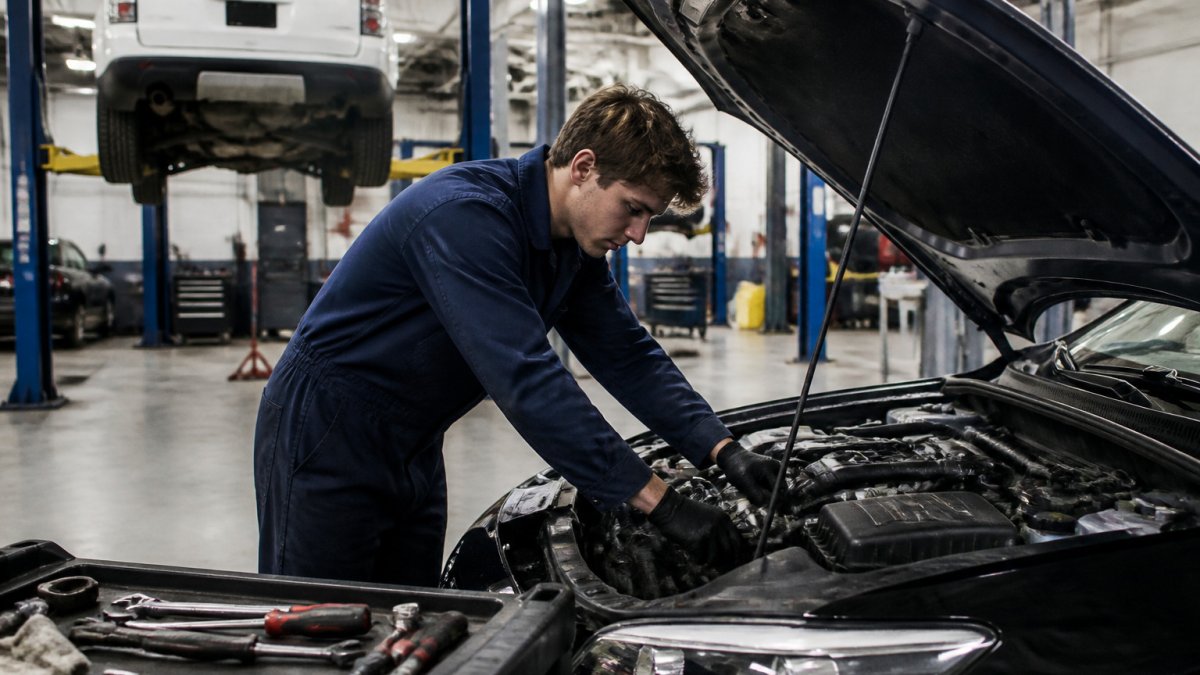
Core tasks learners practise
- Vehicle inspections and pre-delivery checks. Reading a job card, checking fluid levels, measuring tyre tread and brake pad thickness, and recording findings in the correct format.
- Routine servicing. Oil and filter changes, coolant and brake fluid checks, battery testing, and servicing to the manufacturer's schedule rather than to memory.
- Brake work. Measuring discs and drums against specification, inspecting callipers and lines, and understanding why a measurement outside tolerance means replacement rather than adjustment.
- Suspension and steering. Checking bushes, ball joints, shock absorbers and wheel alignment readings, and recognising the symptoms each worn component produces.
- Fault diagnosis. Using a scan tool to pull fault codes, then confirming the cause with a multimeter, oscilloscope or live data rather than replacing parts on suspicion.
- Electrical and electronic systems. Testing circuits, reading wiring diagrams, checking sensors and actuators, and understanding how a single earth fault can affect several systems at once.
Where modern vehicle technology fits
Current workshop demands include:
- Diagnostic software and scan tools. Interpreting fault codes, freeze-frame data and live sensor readings, and knowing when a code points to a cause and when it points to a symptom.
- Hybrid and electric vehicles. High-voltage safety awareness, correct isolation procedures, and an understanding of how regenerative braking and battery management affect familiar systems such as brakes and air conditioning.
- Sensors and driver-assistance systems. Radar, camera and ultrasonic systems that require calibration after windscreen replacement, wheel alignment or suspension work.
- Electronic control units and networked systems. Understanding that modules communicate over vehicle networks, so a fault in one area can present as a symptom in another.
How progress is actually measured
Practical assessment is one common way to track skill development:
- Task checklists and observation sheets signed off by a trainer once a task is performed correctly and safely, without prompting.
- Practical assessments where the learner completes a job end to end, diagnose, repair, verify, while the trainer observes.
- Feedback loops after each assessment, with specific correction rather than a pass or fail.
- Logbooks or skills portfolios that record which tasks have been completed and to what standard, giving an employer something concrete to review.
Pros:
- Builds repeatable skills on real vehicles across the full range of workshop tasks
- Exposes you to the diagnostic equipment and modern systems used in industry
- Assessment checklists show exactly where you need more practice
Cons:
- Practical time can feel demanding compared with lectures
- Progress depends on consistent attendance and effort, and on equipment being available when you need it
The workshop covers a range of core tasks, and learners progress through them with assessment at each stage.
| Task area | What learners do | How progress is shown |
|---|---|---|
| Vehicle inspections | Check fluids, tyre tread and brake pads | Task checklists and observation sheets |
| Routine servicing | Oil, filter, coolant and battery checks | Signed off by a trainer without prompting |
| Brake work | Measure discs and drums against specification | Logbook entries and practical assessments |
| Fault diagnosis | Pull codes, confirm with live data | End-to-end practical assessment |
| Electrical systems | Test circuits and sensors | Feedback after each assessment |
| Hybrid and electric vehicles | Follow isolation procedures | Skills portfolio record |
Workshop Safety Habits Taught From Day One
Safety is an important part of workshop training. Workshop safety is a core part of trade training in Australia.
Pros:
- Safety procedures are practised, not just described
- Risk management becomes a routine part of each task
Cons:
- Strict procedures can slow early progress for some learners
Learning to Use Mechanic Tools and Equipment Properly
Knowing which tool to use, and how to use it without damaging a component, is a core workshop skill.
Pros:
- Familiarity with industry-standard equipment
- Correct tool use reduces wear and damage
Cons:
- Equipment access depends on class sizes and scheduling
Troubleshooting Real Faults Alongside Experienced Trainers
Troubleshooting is an important part of practical automotive training. Learners work through faults step by step, testing their assumptions and checking results.
The aim is to develop a logical method: confirm the symptom, identify likely causes, test, and verify the repair. That method matters more than memorising one fault.
Pros:
- Develops a repeatable diagnostic approach
- Learning alongside experienced staff accelerates judgement
Cons:
- Complex faults can take longer than expected
How Workshop Training Connects to an Automotive Apprenticeship
Workshop training works best when it leads somewhere. Practical workshop training can support pathways into apprenticeships and employment.
Employers often look for evidence of hands-on ability when reviewing candidates. Requirements vary between employers, so check the expectations of any business you apply to.
Choosing a Hands-On Program and Booking Your Next Step at Swann College
The differences between automotive training providers can be checked before you enrol. Use the criteria below as a comparison framework rather than a brochure checklist.
1. Workshop hours and vehicle access
Ask how many hours per week are spent in the workshop, and how many learners share each vehicle and each hoist. A program with generous workshop hours but long queues for equipment delivers less repetition than the timetable suggests. The practical question is: how many full jobs will I complete per week, and on how many different vehicles?
2. Vehicle variety
A workshop stocked with one make and one era of vehicle produces narrow experience. Look for a mix of petrol, diesel, hybrid and electric vehicles, and a spread of ages and systems, so you meet the range of cars you will service in employment.
3. Instructor experience and ratio
Ask who teaches the practical sessions and whether they have current or recent industry experience. A low learner-to-trainer ratio matters most during diagnosis, when a trainer needs to watch how a learner reasons rather than simply confirm the answer.
4. Assessment and evidence of competence
Ask how practical skills are assessed and what evidence you leave with. Observation-based assessment against task checklists, a skills logbook, and feedback after each job give you something an employer can actually review. Written tests alone do not demonstrate that you can complete a repair safely.
5. Safety and risk management
Ask how learners are inducted into workshop safety, how high-voltage and hazardous materials are handled, and what supervision applies around vehicle lifts and electrical systems. A program that treats safety as a standalone module rather than a routine part of every task is telling you something.
6. Currency of curriculum and equipment
Diagnostic software, scan tools and vehicle technology change quickly. Ask how often the curriculum and equipment are reviewed, and whether hybrid and electric vehicle content is embedded or optional.
7. Employer connections and pathways
Ask what proportion of learners move into apprenticeships or employment, and which employers the program deals with. Employer relationships affect how easily you can demonstrate your skills to a hiring business.
Turning workshop training into job readiness
The value of practical training is easiest to see when you map it to what an entry-level employer expects. A learner who can complete a routine service, measure brake components against specification, interpret a fault code and verify a repair can show evidence of competence through assessment records.
Next step at Swann College
Swann College is a Registered Training Organisation offering nationally accredited automotive training, with campuses in Adelaide and Sydney. Our curriculum is developed in association with the Institute of Automotive Mechanical Engineers, and our workshop is designed to reflect a real workplace setting. Students have told us they value the trainers' practical knowledge and the supportive environment.
If you are ready to take the next step, the Enrolment Form is the quickest way to start. Our team can talk you through course options, entry requirements and workshop hours, and you can bring the criteria above to that conversation.
Frequently Asked Questions
What is an automotive workshop training course?
An automotive workshop training course teaches vehicle repair and maintenance through supervised practice on real vehicles in a workshop setting, rather than mostly through lectures or videos. Students work with diagnostic equipment, hand tools and workshop procedures under trainers who have trade experience. Nationally accredited programs in Australia are delivered by Registered Training Organisations, and the practical component is designed to reflect the conditions of a working repair shop. Course length, fees and entry requirements vary, so check current details with Swann College directly.
What skills can you learn in an automotive workshop?
In an automotive workshop you can learn to perform routine servicing, diagnose faults using scan and diagnostic tools, carry out brake, suspension and engine repair procedures, and use workshop equipment such as hoists and torque tools safely.
How does hands-on automotive training prepare you for a mechanic job?
Hands-on training prepares you for a mechanic job by giving you repeated practice on real vehicle systems, so tasks become familiar before you start work.
Why is workshop safety important for automotive students?
Workshop safety matters because vehicle repair involves lifting heavy vehicles, working with fuel, batteries, refrigerants and high-voltage systems, and using power tools. Learning safe habits early, such as using stands rather than jacks alone, isolating electrical systems and wearing appropriate protective equipment, reduces the risk of injury and property damage. Safe working practices are an important part of trade training in Australia.