 listicle
Best Automotive Courses for International Students
Table of Contents
- Why Automotive Courses Are a Strong Choice for International Students
- Automotive Course Entry Requirements for International Students
- Understanding Automotive Mechanic Course Duration and Structure
- Automotive Course Practical Training: What to Expect
- Automotive Training Provider Comparison: Finding Your Fit
- Specialisations: Electric Vehicles, Air Conditioning, and Diesel Systems
- Career Pathways and Employment Opportunities
- Frequently Asked Questions
Last Updated: October 11, 2026
Why Automotive Courses Are a Strong Choice for International Students
International students choosing best automotive courses for international students gain hands-on training that leads directly to skilled migration pathways and employment. Automotive training provides a genuine route into Australia's workforce with qualifications recognised by employers nationwide.
Automotive mechanic training focuses on practical, industry-relevant skills employers need immediately, delivering faster job placement and a clearer pathway to permanent residency sponsorship than university degrees.
Automotive training offers specialisation in electric vehicle technology, diesel systems, or air conditioning servicing, tailoring your qualification to emerging industry demands and competitive advantage.
Automotive Course Entry Requirements for International Students
Entry requirements include academic qualifications, English-language proficiency, visa eligibility, and physical capability.
Academic and Age Requirements
Most Certificate III courses require Year 10 completion or equivalent. Providers assess non-Australian qualifications and accept relevant work experience or mature-age entry (typically 18+).
Minimum age varies by state; confirm with your chosen provider due to occupational health and safety legislation.
English Language Proficiency: Tests and Alternatives
English-language competency is essential for understanding workshop safety instructions, technical manuals, and diagnostic equipment. Most Registered Training Organisations require one of the following:
International English Language Testing System (IELTS): A score of 5.5 overall (with no band below 5.0) is standard; some providers accept IELTS 5.0 if listening and speaking skills are strong.
Pearson Test of English (PTE Academic): Accepted by most providers as equivalent to IELTS. A score of 46-50 aligns with IELTS 5.5.
TOEFL iBT: Some providers accept TOEFL scores; typically 46-59 is considered equivalent to IELTS 5.5.
Cambridge English Qualifications: First Certificate in English (FCE) or higher demonstrates sufficient proficiency and is accepted by most training organisations.
Conditional entry and English support: Some providers offer conditional enrolment with mandatory English language support (4-8 weeks) if your score falls slightly below the threshold.
Student Visa Requirements and Obligations
You must hold a valid subclass 500 (Student) visa. Your training provider must be a Registered Training Organisation (RTO) listed on the National Register.
Your visa comes with specific conditions:
Course progress: You must maintain 80% attendance; falling below this threshold can trigger visa cancellation.
Work-study balance: You may work up to 20 hours per week during term time and unlimited hours during breaks. Many students work part-time in automotive workshops, gaining practical experience.
Course duration: Your visa is granted for the length of your course plus a small buffer (typically 1-2 months). If you extend your course or change providers, you must apply for a new visa. Plan your study timeline carefully to avoid visa complications.
Health insurance: You must maintain Overseas Student Health Cover (OSHC) throughout your visa (typically AUD $200-$400 annually).
Physical Capability and Safety Assessment
Automotive work demands physical capability: lifting and carrying tools (5-20 kg), standing for extended periods, working in varying temperatures, fine motor control, and exposure to oils, solvents, and dust.
Providers conduct a practical assessment during enrolment. If you have physical limitations or disabilities, discuss accommodations (modified workstations, adjusted tasks, assistive equipment) with your provider early.
Documentation Checklist for International Student Enrolment
Prepare the following before applying:
- Passport (valid for the duration of your intended stay)
- Year 10 or equivalent qualification certificate (or mature-age declaration if applicable)
- English-language test result (IELTS, PTE, TOEFL, or Cambridge)
- Proof of financial capacity (bank statements or sponsor documentation showing you can cover tuition and living costs)
- Overseas Student Health Cover (OSHC) quote or confirmation
- Character reference or police clearance
- Completed enrolment form and course agreement
Your training provider will guide you through the specific documentation required for your visa application once you've been offered a place.
Understanding Automotive Mechanic Course Duration and Structure
Certificate III and IV in Automotive Mechanic
Certificate III in Automotive Mechanic typically runs 12-18 months full-time, covering fundamental vehicle servicing, diagnosis, and repair across all systems: engine mechanics, electrical, braking, suspension, and steering.
The structure combines classroom theory with extensive workshop practice on equipment and processes you'll encounter in actual automotive businesses, ensuring job-ready graduates.
Certificate IV in Automotive Mechanic (12-15 months) advances skills into diagnostics and management. Many students progress from Certificate III to Certificate IV part-time while working.
Diploma and Advanced Certifications
Diploma of Automotive Technology or Management (18-24 months full-time) positions you for workshop management, technical leadership, or business ownership, covering fleet management, workshop operations, advanced diagnostics, and staff supervision.
Advanced specialisation certificates in electric vehicles, air conditioning, or diesel systems (4-8 weeks) can be completed alongside or after your main qualification.
Automotive Course Practical Training: What to Expect
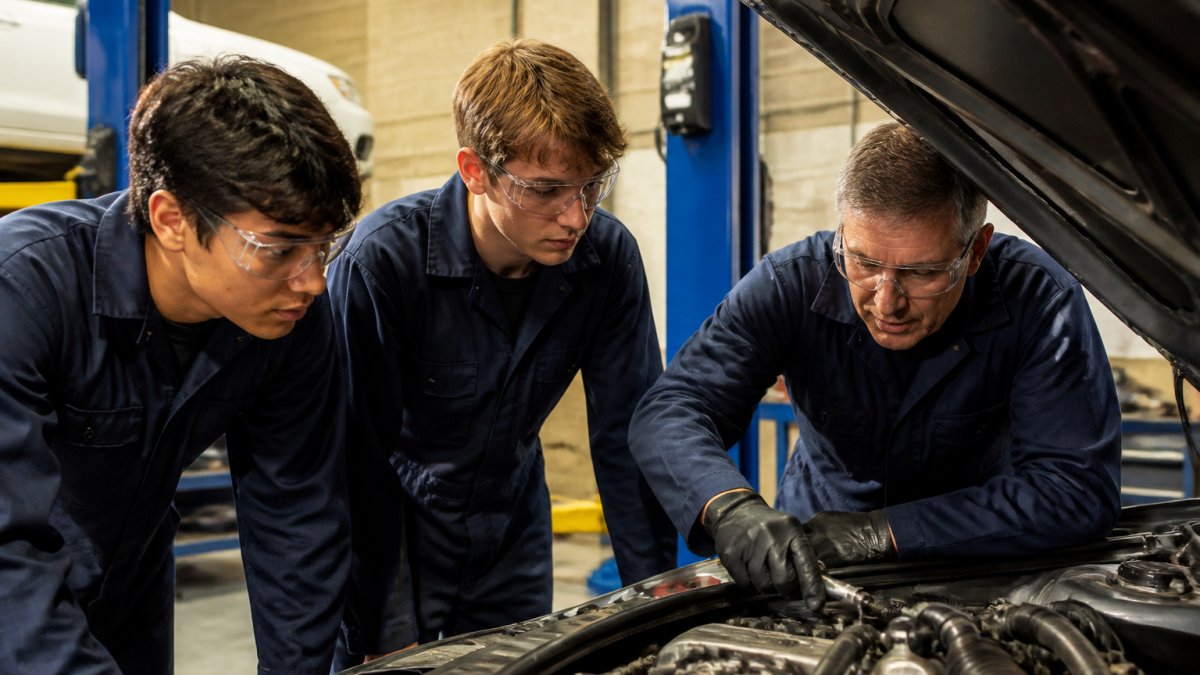
Hands-on workshop training is where best automotive courses for international students prove their value. You'll work on real vehicles using diagnostic equipment, hand tools, and lifting equipment, performing actual servicing and repairs.
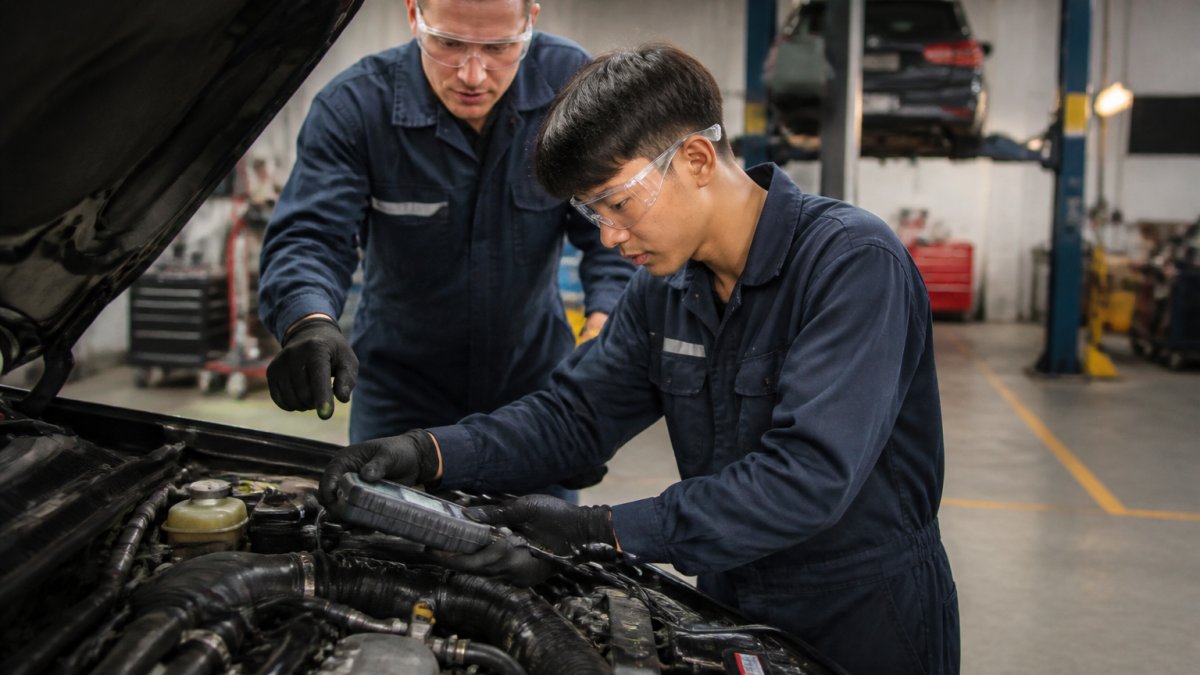
Daily workshop sessions (4-6 hours) combine supervised practical work with peer learning, rotating through vehicle systems from basic servicing to complex electrical diagnostics, with safety embedded throughout.
Real-world servicing teaches troubleshooting skills classroom instruction cannot develop, mirroring how professional mechanics work and easing the transition to employment.
Assessment combines observation, work samples, and practical projects (e.g., diagnosing and repairing a vehicle with an unknown fault) that demonstrate competency across multiple systems.
Automotive Training Provider Comparison: Finding Your Fit
Choosing a training provider is crucial. Providers differ significantly in workshop facilities, trainer expertise, course duration, cost, and international student support.
Key Comparison Criteria
Workshop facilities and equipment: Ask whether providers have diagnostic scanning equipment, electric vehicle training bays, air conditioning servicing equipment, and real customer vehicles. Providers operating commercial workshops alongside training deliver more authentic, industry-relevant instruction.
Trainer expertise and qualifications: Ask about trainers' automotive workshop experience, current industry involvement, professional certifications, and specialisations. Trainers with recent mechanic experience deliver credible, practical instruction and better employment preparation.
Course duration and delivery mode: Certificate III runs 12-18 months full-time or 2-3 years part-time.
Location and accessibility: Providers in major cities offer better access to public transport, employment opportunities, and international student support. Consider proximity to public transport, automotive industry hubs, and support services.
Tuition fees and total cost of study: Ask about flexible payment options, scholarships, and recognition of prior learning.
Specialisation options: Confirm your provider offers electric vehicles, air conditioning, or diesel systems specialisation.
International student support: Evaluate whether your provider offers visa guidance, accommodation assistance, English language support, career counselling, and job placement assistance. Providers with established international student cohorts typically have better support infrastructure.
Qualification recognition and accreditation: Verify the provider is listed on the National Register of Vocational Education and Training (NRVET) and whether qualifications are recognised in your home country.
Employment outcomes and graduate pathways: Ask for graduate employment rates, starting salaries, employer partnerships, and job placement assistance. Providers with strong employer relationships typically have better outcomes.
Comparison Framework: Questions to Ask Each Provider
Before enrolling, contact at least three providers and ask:
- What is your total tuition fee, and what does it include (materials, tools, uniforms)?
- What is the course duration, and what are the weekly workshop hours?
- What qualifications and experience do your trainers have?
- Can I visit your workshop and observe a training session?
- What is your graduate employment rate, and do you offer job placement support?
- What international student support services do you provide?
- Do you offer specialisation options, and at what additional cost?
- Can you provide references from recent international student graduates?
- What is your policy on course deferrals or changes if my circumstances change?
- Are there payment plans or scholarships available for international students?
Specialisations: Electric Vehicles, Air Conditioning, and Diesel Systems
Electric vehicle training is increasingly essential. As the automotive industry transitions to electric powertrains, mechanics with EV knowledge command premium employment prospects. EV-specific training covers battery systems, electric motors, high-voltage safety, and charging infrastructure, skills that position you ahead of technicians without this specialisation.
Automotive air conditioning requires dedicated certification. This specialisation covers refrigerant handling, system diagnostics, and environmental compliance. Air conditioning specialists earn strong hourly rates, and the qualification is relatively quick, making it ideal for upskilling while working.
Diesel system specialisation appeals to heavy vehicle technicians and those working in rural or mining sectors. Diesel engines differ significantly from petrol engines in fuel injection, compression, and maintenance requirements. Diesel specialists work on trucks, earthmoving equipment, and industrial machinery, sectors with consistent demand for skilled technicians.
Career Pathways and Employment Opportunities
Completing best automotive courses for international students opens multiple career directions. Many graduates work as vehicle service technicians in independent workshops or dealerships. Others specialise in fleet maintenance, servicing multiple vehicles for transport companies or government agencies. Some transition into diagnostic roles, using advanced equipment to identify complex faults.
Workshop ownership is achievable within 5-10 years of qualified experience. Understanding business management through higher-level qualifications positions you for this pathway. Many successful workshop owners started as apprentices or trainees, built technical expertise, then established their own operations.
Skilled migration sponsorship becomes viable once you've gained Australian work experience and demonstrated competency. Automotive mechanics are on skilled occupation lists in most states, meaning employers can sponsor your permanent residency once you meet experience requirements. This pathway, training, gaining experience, securing sponsorship, is realistic and achievable.
Ongoing specialisation keeps your career progressing. Electric vehicle technology, diagnostic equipment, and workshop management skills all enhance your market value. Continuing professional development through short courses maintains your competitive advantage as the industry evolves.
Automotive training delivers practical, nationally recognised qualifications that lead directly to employment and permanent residency pathways. At Swann College, we combine hands-on workshop experience with industry-current curriculum developed alongside the Institute of Automotive Mechanical Engineers. If you're ready to launch a career in automotive servicing with qualifications employers value, enrol with Swann College and gain the practical skills that secure your future in Australia's automotive industry.
Frequently Asked Questions
How long does an automotive mechanic course typically take?
Most automotive mechanic courses in Australia range from 12 to 18 months for Certificate III and IV qualifications. Diploma-level programmes take longer, typically 18-24 months. Duration depends on whether you study full-time or part-time, and whether you combine classroom learning with on-the-job experience through apprenticeships or internships. Swann College offers flexible scheduling to suit your circumstances.
What are the entry requirements for international students in automotive courses?
International students typically need to meet English language proficiency requirements, hold a valid passport, and have completed secondary education or equivalent. Contact your training provider for specific admission criteria.
Will an automotive course from an Australian training provider help me get permanent residency?
Completing a nationally accredited automotive qualification in Australia can support your skilled migration pathway. Automotive mechanic roles are on Australia's skilled occupation lists, and employers often sponsor qualified technicians. However, permanent residency depends on multiple factors including your qualifications, work experience, English proficiency, and employer sponsorship. A qualification from a Registered Training Organisation like Swann College strengthens your profile, but you should seek migration advice to understand your specific eligibility.
How hands-on is the practical training in automotive courses?
Quality automotive courses combine classroom theory with extensive workshop practice on real vehicles. Swann College operates professional workshop facilities that mirror real workplace settings, allowing you to work on actual cars using industry-standard tools and equipment. You'll learn vehicle diagnosis, repair, servicing, and maintenance under trainer supervision.
What specialisations are available in automotive courses for international students?
Common specialisations include automotive air conditioning, electric vehicle systems, diesel mechanics, and heavy vehicle maintenance. These advanced certifications allow you to focus on high-demand areas of the industry. Electric vehicle training is increasingly important as the automotive sector shifts toward cleaner technologies. Swann College offers specialised short courses and advanced certifications in these areas, allowing you to build expertise beyond basic mechanic qualifications and improve your career prospects.